


Hargreaves Lansdown SIPP Review 2026: The UK's Most Popular Platform - But Is It Right for You?
- Alpesh Patel
- Mar 24
- 5 min read

Updated: Mar 26

Hargreaves Lansdown is where most self-directed UK investors start — and where many stay.
With over 1.8 million active clients and £155 billion under administration, HL is by some distance the UK’s largest retail investment platform. Its brand is built on service, simplicity, and breadth - a well-designed interface, strong research tools, excellent customer support, and access to virtually every listed stock, fund, and ETF available to UK retail investors.
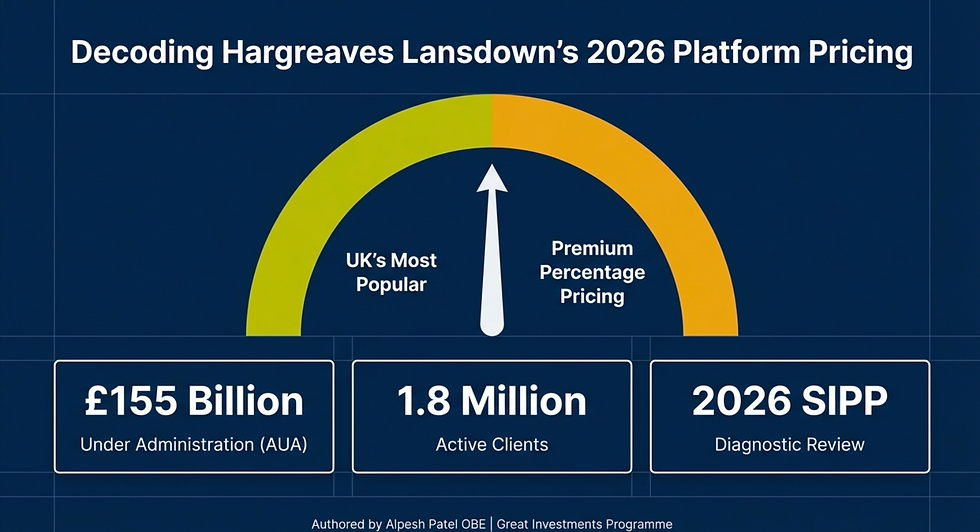
The question for 2026 is whether HL’s premium pricing; it is one of the most expensive percentage-based platforms in the UK is still justified for investors with larger portfolios, and how it compares to the flat-fee alternatives that have grown significantly in recent years.
Alpesh Patel OBE is a hedge fund manager, Bloomberg TV alumnus, Financial Times author, and former Visiting Fellow at Corpus Christi College, Oxford. Many GIP members use Hargreaves Lansdown as their SIPP platform — this review helps them assess whether it remains the optimal choice as their portfolio grows.
HL SIPP Charges 2026: The Full Picture
Hargreaves Lansdown’s SIPP charges are percentage-based and tiered. For shares and ETFs held within a SIPP, the platform fee is capped at £200 per year. For funds (OEICs and unit trusts), the fee is 0.45% on the first £250,000, 0.25% on the next £750,000, 0.1% on the next £1 million, and free above £2 million — uncapped.
This distinction is critical. If you hold individual stocks and ETFs (which a GIP self-directed investor does), the £200/year cap makes HL highly competitive on cost for any portfolio above £44,000 in value.

If you hold funds, the percentage charge applies without a cap below £2 million, making HL expensive for larger fund-based portfolios. HL charges dealing commissions of £11.95 per share trade (reducing to £8.95 with 10+ trades per month, and £5.95 for frequent traders).
HL vs Competitors: The Platform Cost Comparison
For a self-directed investor holding shares and ETFs in their SIPP, the annual platform cost comparison for different portfolio sizes:
£100,000 portfolio: HL £200/yr | AJ Bell £150/yr | Interactive Investor £240/yr
£250,000 portfolio: HL £200/yr (capped) | AJ Bell £150/yr | Interactive Investor £240/yr
£500,000 portfolio: HL £200/yr (capped) | AJ Bell £150/yr | Interactive Investor £360/yr
For portfolios above £100,000 in shares and ETFs, HL’s £200 cap makes it one of the most cost-competitive platforms available for active stock pickers. AJ Bell is marginally cheaper at the platform level. Interactive Investor’s flat-fee model becomes more cost-effective only for very large portfolios.
Where HL Genuinely Excels
HL’s genuine strengths are its research tools, breadth of investment options, and customer service. The platform provides access to UK and international equities, funds, ETFs, investment trusts, bonds, and cash products in a single account. Their mobile app is widely regarded as the best in the UK retail investment sector. Customer service response times consistently rank among the highest in the industry.
Where HL Falls Short
HL’s dealing commissions (£11.95 per trade for infrequent traders) are above the market average. Interactive Brokers charges as little as £1–3 per trade. For a GIP investor conducting quarterly portfolio reviews with 4–8 trades per review, HL’s dealing costs add £48–£96 per quarter — meaningful but not prohibitive for portfolios above £100,000.

HL also came under FCA scrutiny following the Woodford Equity Income Fund scandal, in which HL continued to recommend the fund on its Wealth 150 list despite warning signs of deteriorating liquidity. This does not affect the quality of HL as an execution platform for self-directed investors who make their own stock selection decisions — but it is relevant context when evaluating HL’s research and recommendation services.
The Verdict: Is HL Right for Your SIPP in 2026?
For a self-directed investor holding individual stocks and ETFs — the GIP model — HL is a strong choice for portfolios of £50,000 to £500,000. The £200/year cap makes the platform competitive on cost, the research tools are excellent, and the service quality is genuinely the best in the UK retail market. For portfolios above £500,000, AJ Bell and Interactive Brokers become increasingly attractive alternatives worth evaluating.
Frequently Asked Questions: Hargreaves Lansdown SIPP
What are the Hargreaves Lansdown SIPP charges in 2026?
For shares and ETFs: 0.45% per year, capped at £200 annually. Dealing commissions are £11.95 per trade (reducing to £8.95 for 10+ trades/month and £5.95 for 20+ trades/month). For funds held in the SIPP: 0.45% on first £250,000, 0.25% on next £750,000, no annual cap below £2 million.
Is Hargreaves Lansdown SIPP safe?
Yes. Hargreaves Lansdown is FCA-authorised, listed on the London Stock Exchange (FTSE 250), and subject to FSCS protection up to £85,000. Client assets are held separately from HL’s own balance sheet under FCA custody rules.
Is HL SIPP better than AJ Bell or Interactive Investor?
For portfolios of £50,000–£500,000 in shares and ETFs, HL’s £200 cap makes it competitive. AJ Bell is slightly cheaper on platform charges. Interactive Investor’s flat fee becomes most cost-effective for large portfolios above £500,000. Interactive Brokers is most cost-effective for active traders due to ultra-low dealing commissions.
Can I hold international stocks in an HL SIPP?
Yes. HL provides access to over 2,000 overseas stocks across major international exchanges including the NYSE, NASDAQ, and major European exchanges. Most GIP-approved stocks listed on US exchanges are accessible. FX conversion charges apply (currently 1% for trades up to £5,000, reducing to 0.5% for trades above £10,000).
What is the HL Wealth Shortlist?
The HL Wealth Shortlist is a curated list of funds selected by HL’s research team as standout options in their sectors. It replaced the previous Wealth 150 list following the Woodford fund controversy in 2019. While useful as a starting point, it reflects HL’s analysts’ qualitative judgements and is not a substitute for quantitative screening. Self-directed stock pickers using the GIP framework bypass the Wealth Shortlist entirely.
If you are evaluating SIPP platforms or want to ensure your current platform is the right fit for the GIP approach, book a free portfolio review. Alpesh’s team can help you assess both your platform choice and your investment approach simultaneously.
Sources & Further Reading
Hargreaves Lansdown — SIPP charges, dealing commissions, and platform features (2026). hl.co.uk/pensions/sipp
Financial Conduct Authority — Consumer Duty thematic review and Woodford Equity Income Fund review. fca.org.uk
Financial Times — SIPP platform comparison and HL fee structure analysis. ft.com/personal-finance
Good Money Guide — Best SIPP providers 2026. goodmoneyguide.com/investing/sipps
Which? — SIPP and investment platform reviews. which.co.uk/money/investing
AJ Bell — SIPP charges and platform comparison data. ajbell.co.uk/sipp
Interactive Investor — Flat fee SIPP pricing and plan comparison. ii.co.uk/sipp
Times Money Mentor — UK investment platform comparison. thetimes.co.uk/money-mentor
Disclaimer: This article is for educational purposes only. Fee figures are based on publicly available HL pricing as at March 2026 and are subject to change. Always verify current charges directly with the relevant provider.
Alpesh Patel OBE


I thought the Government protection is now at £125000, or have I got that wrong?