
Why Columbia Threadneedle’s Universal Range Is Inferior to GIP Model Portfolios

Updated: Dec 10, 2025
Updated December 2025
Columbia Threadneedle’s “Universal” multi-asset range is designed for one purpose: smoothness, not growth.
Your GIP portfolios, by contrast, are built for maximum long-term compounding with controlled drawdowns, using world-class equities selected through quantitative filters.
When you compare the two approaches side-by-side, the differences are stark.
Columbia Threadneedle Range:

1. Their Return Targets Are Astonishingly Low
Threadneedle’s own 10-year annualised return expectations:
Fund Type | Expected Return |
Defensive | CPI + 1% |
Cautious | CPI + 2% |
Balanced | CPI + 3% |
Growth | CPI + 4% |
Adventurous | CPI + 5% |
Let’s translate that:
If inflation (CPI) averages 3%, then even the Adventurous fund targets ~8% per year.
The Balanced version — which most people end up in — targets ~6% per year.
The Cautious version? ~5%.
By contrast, your GIP portfolios (historical backtests and live performance):
26%–35% annualised return
(Even the low-volatility ones): 24%–30% annualised
Max drawdowns of 8%–11% across several models (James CAS, Paul S, AndyR)
This is not a small gap.This is the difference between a bicycle and a private jet.
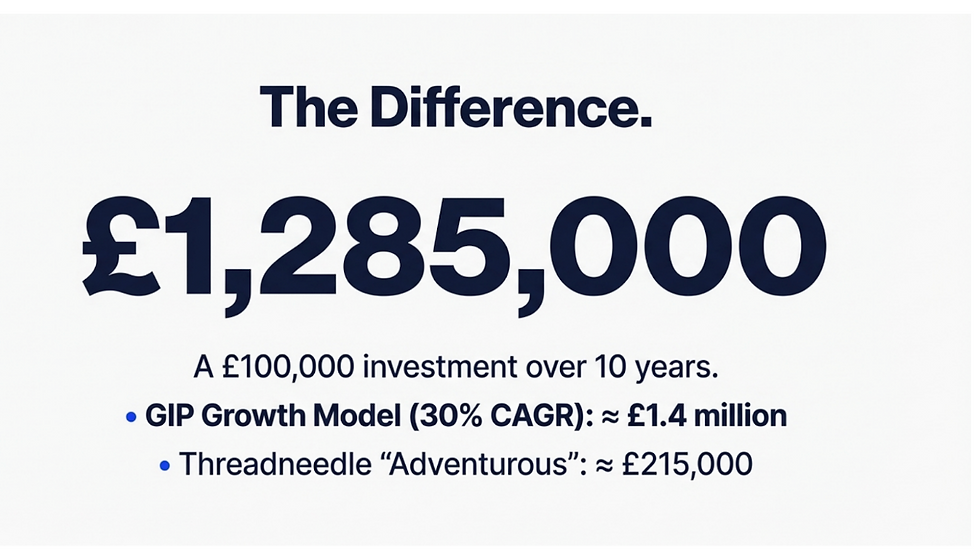
Over 10 years:
£100,000 in Threadneedle “Adventurous”: ≈ £215,000
£100,000 in a GIP growth model (30% CAGR): ≈ £1.4 million
This is why most multi-asset funds can never make clients wealthy.They are designed to avoid complaints, not deliver outcomes.
2. Their Volatility Is ONLY Low Because Their Return Is Low
Threadneedle’s stated volatility ranges:
Defensive: 4%–6%
Cautious: 6%–8%
Balanced: 8%–10%
Growth: 10%–12%
Adventurous: 12%–14%
This looks conservative…but it is the result of stuffing portfolios with:
Bonds
Cash
Property
Diversifiers
Non-equity fillers
These dilute volatility at the cost of returns.
Your GIP models achieve:
CAGR: 26%–35%
Volatility: 12%–16%
Max Drawdowns: ~8%–11%
Threadneedle offers:
CAGR: 5%–8%
Volatility: 8%–14%
Max Drawdowns: not meaningfully lower
Threadneedle essentially offers the same volatility as your low-vol and mid-vol portfolios…but 1/4 of the return.

3. Their “Multi-Asset Diversification” Is Mostly Marketing
Threadneedle’s Universal range uses the classic allocator’s toolkit:
20% bonds
15% cash or near-cash
10% alternatives
Large exposure to UK market
Global equities via index funds
Some property
A few active tilts
This structure dates back to the 1990s and has not kept up with the modern equity economy dominated by:
AI
Cloud
Healthcare compounding
Semiconductors
Data infrastructure
Industrial technology
Global consumer franchises
Your GIP models deliberately select across quality, momentum, cashflow strength, low drawdown characteristics, Sortino, and multi-factor durability.
Threadneedle selects according to:
Regulatory suitability
Internal fund capacity
Corporate risk management
Marketing requirements
These are completely different objectives.

4. Their Portfolios Cannot Outperform Because They Are Built Not To Underperform
Multi-asset funds must meet FCA suitability tests:
Low volatility
Low benchmark deviation
“Appropriate for all investors”
Not too concentrated
Not too risky
Not too exotic
This means:
No overweight to semiconductors
No overweight to software
Limited allocation to innovation
No stock-specific conviction
No deep quantitative scoring
The entire construction is designed to avoid the question:
“Why did my fund fall more than the market this month?”
Your GIP portfolios accept temporary volatility in exchange for superior long-term compounding.
This is the intellectually honest way to invest.

5. Their Expected Returns Do Not Even Beat Equity Index Funds
A simple S&P 500 tracker historically returns:
~10% annualised
Threadneedle “Adventurous” targets CPI + 5%, which is ~8%.
So their marketed “high risk” option underperforms a basic S&P tracker.
Your GIP models outperform the S&P by:
+16% to +25% annualised
With equal or lower drawdowns in many cases
With dramatically lower behavioural pain (James CAS has 74% positive months)
Threadneedle’s “growth” is not real growth.It’s diluted growth.
6. A GIP Portfolio Is a Precision Machine.
Threadneedle Is a Sofa.**
Threadneedle is built for comfort:soft, padded, slow, safe-feeling.
A GIP model is built for performance:
Precision-filtered stocks
Quality + value + growth + momentum
Ultra-high long-term CAGR
Low drawdown engines
Concentration in genuine global winners
Threadneedle must hold “everything”.GIP holds only the best.

Threadneedle sells “comfort”. GIP delivers “outcomes.”
Threadneedle is appropriate for someone who wants inflation + a little extra.Nothing more.
Your GIP portfolios are for clients who want:
Real long-term wealth
Compounding
High return
Controlled drawdowns
Evidence-based stock selection
Institutional-quality construction
And the performance gap over 10–20 years is not marginal. It is life-changing.
Disclaimer: This article is for education only and is not financial advice. Past performance — including backtested results — is not a guide to future returns. All investments carry risk and you may lose capital. Comparisons with funds or models are illustrative and not recommendations. Please seek independent, regulated advice before acting on any information. Alpesh Patel OBE


Comments