
Do Female Investors Outperform Men? The $34 Trillion Wealth Shift

Updated April 2026

Introduction - The Quiet Revolution in Capital Markets

For decades, the cultural archetype of capital markets has been the “boys’ club” - a high-testosterone arena defined by rapid-fire trades, ego-driven speculation, and a win-at-all-costs mentality.
Yet beneath the noise of the trading floor, a quiet revolution is taking place.
The traditional gatekeepers are being bypassed by a new cohort of investors who are not only entering the market in record numbers — but are also fundamentally outperforming the old guard.
The reality is clear: Female investors are no longer just participants. They are becoming the architects of market stability.
By leveraging a more disciplined, research-heavy approach, they are reshaping the global financial landscape and challenging long-held assumptions about risk.

Alpesh Patel OBE is a hedge fund manager, Bloomberg TV alumnus, Financial Times author, and former Visiting Fellow at Corpus Christi College, Oxford.
The Performance Paradox - Why Female Investors Outperform Men
In behavioural economics, the concept of overconfidence bias is well documented - the tendency to overestimate one’s knowledge and predictive ability.

A survey by the Global Financial Literacy Excellence Centre (GFLEC) revealed:
Only 9% of women believe they are better investors than men
Yet the data tells a different story.
A landmark study from the University of California, Berkeley, analysing 35,000 brokerage accounts found that:
Women outperform men by approximately 1% annually. At first glance, this may seem marginal. It isn’t. With average real returns around 5%, a 1% edge represents a material compounding advantage over time.
The behavioural drivers:
Lower overconfidence
Reduced trading frequency
Greater patience during volatility
MIT research reinforces this: The investors most likely to panic sell are men aged 45+ with high self-rated expertise.
Conversely, women show a stronger tendency to hold through volatility, avoiding the high-risk, low-reward game of market timing.
“The enemy of every good long-term decision is not bad information. It is an untrained nervous system.”
Analysis
What is often mischaracterised as “conservatism” is, in reality: Sophisticated risk management
A disciplined, low-activity strategy is not passive, it is one of the most powerful engines of long-term capital appreciation.
The $34 Trillion Shift - A Massive Reallocation of Global Wealth
The financial industry is undergoing a tectonic shift in capital control.
Women’s share of global wealth is rising rapidly:
Year | Wealth Controlled by Women | Share |
2019 | $11 trillion* | 31% |
2023 | $18 trillion | 34% |
2030F | $34 trillion | 38% |
This is not a marginal trend - it is a structural transformation.
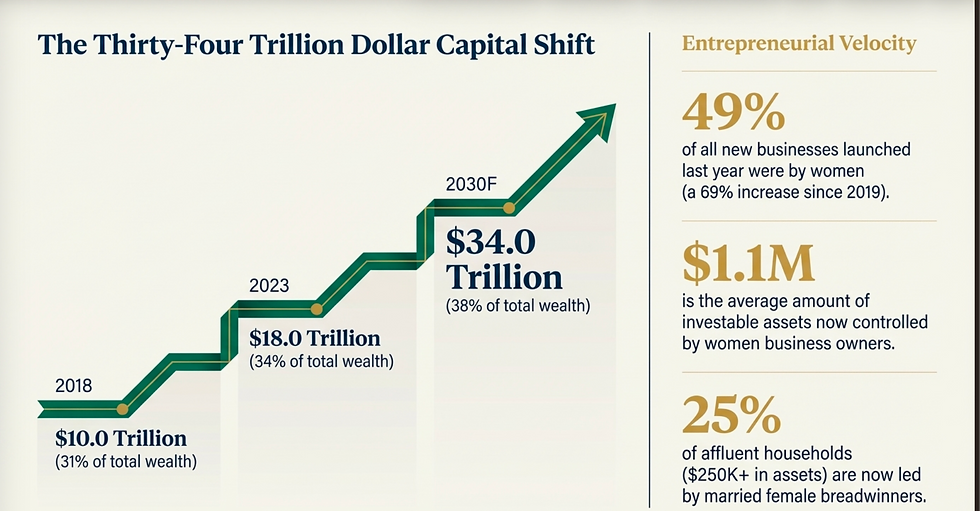
This shift is creating a new investor profile:
The Married Breadwinner (≈25% of affluent households)
The Single Breadwinner (fast-growing segment)
Analysis
This wealth transfer demands a recalibration of the advisory model.
As capital shifts toward investors who prioritise longevity over leverage: The industry must move from transactions → relationships
Those who fail to adapt risk becoming obsolete.
The Rise of the Female Founder - From Income to Equity
The engine behind this wealth shift is entrepreneurship.
Women now launch 49% of all new businesses
A 69% increase since 2019
This marks a critical transition: Salaried wealth → Equity wealth
Women business owners now control:
~$1.1 million in investable assets (on average)
Analysis
Entrepreneurship is the ultimate driver of capital formation.
By moving from earners to owners, women are:
Scaling wealth
Increasing liquidity
Expanding influence across asset classes
The Advice Gap - Why Outperformance Doesn’t Equal Confidence
A striking paradox is emerging.
While performance improves, confidence declines:
Confidence fell from 56.5% (2019) to 16.3% (2023)
This is not weakness it is awareness.
It reflects a deeper understanding of market complexity and risk.
This shift is driving:
A 6x increase in demand for advisor engagement
Preference for education, clarity, and transparency
When women leave advisors, the reasons are telling:
Poor customer service: 39%
Lack of personal connection: 32%
Analysis
The “return-only” model is breaking.
The future is partnership-driven investing
The Retirement Challenge - Closing the Gender Pension Gap
Despite strong investment behaviour, structural challenges remain.

UK data highlights the gap:
Women: £42,600
Men: £76,700
Globally:
Women earn ~84% of male income
Key drivers:
Career breaks
Pay disparity
Longer life expectancy
The solution is clear:
Start early
Invest consistently
Leverage compounding
“The earlier women begin saving, the more time their money has to grow.”
Analysis
Financial literacy is not just a skill.
It is a form of economic independence
The Future Belongs to Disciplined Investors
This shift is both behavioural and structural.
The defining traits of successful investors today:
Patience
Discipline
Long-term thinking
Low trading frequency
These are not new traits.
They are simply being recognised and validated at scale.
As $34 trillion moves into the hands of investors who prioritise stability over speculation:
The definition of “smart investing” is changing.

Call to Action
If you want to build a disciplined, long-term investment strategy: https://www.campaignforamillion.com
Learn how to avoid costly behavioural mistakes and take control of your financial future. Disclaimer:
This article is for educational purposes only and does not constitute financial advice. Investments can fall as well as rise in value, and past performance is not a reliable indicator of future results. Always conduct your own research or consult a qualified financial adviser before making investment decisions.
Alpesh Patel OBE


Comments