
Unlocking Investment Success: 15 Essential Concepts for Better Performance

Updated: May 5

The average retail investor earns 4.4% negative abnormal annual returns before costs. After costs, the picture worsens. The most active traders underperform passive investors by more than 7% per year. Yet, most investors believe they are above average, which is, of course, a statistical impossibility.
That gap between belief and reality is not about intelligence. It is about fifteen concepts that professional investors spend years learning and that no one ever explains clearly to the people who need them most.
This guide draws from Nobel Prize-winning research, decades of empirical market data, and the same quantitative framework used in the Great Investments Programme.
Work through each concept in the order they build on each other. Then take the twelve-question self-assessment quiz in the downloadable guide at the bottom of this page.
Why Most Investors Never Learn These Investing Concepts
The financial services industry has a structural problem: it is paid to manage your money, not to educate you. Fund managers are compensated on assets under management, not on the quality of what they teach you.
The concepts in this guide—particularly survivorship bias, tax drag, and behavioural biases—are deeply inconvenient for anyone trying to sell you an actively managed fund with a 1.5% annual charge.
The Great Investments Programme exists to correct that: give investors the framework that professionals use, explain it plainly, and let people make genuinely informed decisions about their own money.
1. Compounding: The Eighth Wonder of the World of Investing
Compounding is the process by which an asset's earnings are reinvested to generate further earnings. The result is exponential growth, not linear. This is why starting early matters far more than most people intuitively grasp.
The Rule of 72 gives you a quick check: divide 72 by your expected annual return to find how many years it takes your money to double. At 7%, that is just over ten years. At 4%, it takes eighteen.
A 1% annual fee on a £100,000 portfolio quietly costs over £45,000 in lost compounding over thirty years. This is not because the fee is large in year one, but because it removes capital that would otherwise have kept growing.
Warren Buffett acquired 99% of his wealth after the age of fifty-two. That is not because he became a better investor in his fifties. It is because compound growth does its heaviest lifting in the final decades of a long run.
2. Diversification and Correlation: The Free Lunch That Has Limits in Investing
Harry Markowitz won the Nobel Prize for formalising what practitioners already suspected: combining assets whose returns are not perfectly correlated reduces portfolio risk without necessarily reducing expected returns.
Twenty randomly selected UK equities eliminate roughly 80% of firm-specific risk. However, during the 2008 financial crisis, correlations spiked to near 1.0. Equities, bonds, property, and commodities that had appeared uncorrelated moved together at the worst possible moment.
True diversification requires low correlation between holdings, not simply owning more names. Many investors hold dozens of funds that turn out to contain the same thirty underlying companies. That is concentration dressed up in paperwork.
3. Fat Tails and Black Swans: Markets Crash More Often Than Models Predict
A normal distribution assigns near-zero probability to a 22% single-day drop in the Dow Jones. In 1987, it happened. A 34% decline in 33 days would be called essentially impossible by standard models. In 2020, it happened.
The technical term is leptokurtosis—financial return distributions have fatter tails than the normal distribution, meaning extreme events occur far more frequently than standard risk models predict.
Mandelbrot documented this in 1963; Fama confirmed it in 1965. Any risk model assuming normally distributed returns will understate your real downside.
In the Great Investments Programme, we show investors their portfolio performance across every major historical drawdown, stock by stock, month by month. The goal is to convert panic into informed patience. Investors who understand what has happened before do not sell at the bottom.
4. Behavioural Biases: The Risk Between Your Ears
Kahneman and Tversky demonstrated in 1979 that people feel losses roughly 2.5 times more acutely than equivalent gains. More than 65% of retail investment decisions are driven by emotion rather than analysis, according to IFSA Network research from 2025.
Barber and Odean found in 2000 that the most active retail traders underperformed the market by 6.5% annually. This was not due to a lack of intelligence, but rather overconfidence driving excess trading. The six most costly biases are overconfidence, loss aversion, herding, anchoring, availability bias, and mental accounting.
I wrote about Kahneman's and Thaler's work in the Financial Times before each of them separately won the Nobel Prize. The mind matters more than the data—not because data is unimportant, but because the data is useless if your behaviour prevents you from applying it.
5. Sequence of Returns Risk: When Your Returns Happen Matters As Much As What They Are
Two investors retire with identical portfolios and experience identical average annual returns over thirty years. One runs out of money in year fourteen; the other's portfolio survives. The only difference is the order in which the returns arrived.
This is sequence of returns risk, and it is the most underappreciated threat to UK pension drawdown. A market crash in the first three to five years forces you to sell units at low prices. That capital never recovers because it is no longer invested when markets bounce.
The simplest defence is the most ignored: keep one to two years of living expenses in cash. This way, you are never forced to sell investments at the worst possible time. T. Rowe Price and Capital Group have both documented this pattern extensively. Maintaining a cash buffer sounds obvious when you say it out loud, yet most people do not have it in place.
6. Survivorship Bias: You Only See the Funds That Made It
Of 10,872 US equity mutual funds studied between 1991 and 2020, nearly a third no longer existed by the end of the period. Dimensional Fund Advisors found that survivorship bias overstates median fund alpha by approximately 50%.
Only 2.4% of all funds are survivors, but all funds—including the closed ones—earned reliably positive alpha. When your fund manager shows you their track record, ask how many of their other funds were quietly closed during the same period. That question usually changes the picture considerably.
7. Inflation and Real Returns: What Your Money Is Actually Worth
A 7% nominal return during 4% inflation produces a real return of approximately 2.9%, not 7%. In 2022, UK inflation hit 11.1%. A cash savings account returning 2% that year produced a real return of negative 8.2%.
The money was still there in nominal terms; in terms of what it could actually buy, it shrank by more than 8% in a single year.
A pound in 1990 has the purchasing power of approximately 46 pence today in real UK CPI terms. Holding cash because it feels safe is not conservative; it is a guaranteed slow erosion of purchasing power.
8. Mean Reversion: Overvalued Does Not Mean Will Fall Tomorrow
Mean reversion is the tendency for asset prices to drift back towards long-run historical averages over time. Fama and French documented in 1988 that between 25% and 40% of three-to-five-year return variation is explained by negative serial correlation. CAPE ratios above 30 have historically preceded below-average ten-year equity returns.
A Utrecht University study covering 18 OECD markets from 1900 to 2009 found the average half-life of a price shock to be 13.8 years—mean reversion is real and dangerously slow. You can exhaust your capital waiting for it.
9. Kelly Criterion and Position Sizing: How Much to Put in Any One Investment
John Kelly derived the mathematically optimal fraction of capital to allocate to any investment in 1956. The formula is = (bp - q) / b, where b is the odds, p is the probability of winning, and q is the probability of losing. Overbetting the Kelly fraction guarantees eventual ruin, even when you have a genuine edge.
Most professional investors use half or quarter-Kelly to reduce maximum drawdowns, accepting a modest reduction in long-run growth in exchange for a portfolio they can actually hold.
The practical rule: never risk more than 1% to 3% of total capital on any single position where the edge is genuinely uncertain. Conviction is not an edge calculation.
10. Leverage and Margin Risk: Amplification Goes Both Ways
A 2x leveraged ETF tracking the S&P 500 during a 50% drawdown produces approximately a 95% loss—not 100%, but 95% due to daily rebalancing mechanics and volatility decay.
MIT Sloan research from 2022 found that retail investors lose significantly in options markets from bid-ask spreads of 9% to 10% on earnings plays—costs largely invisible to the people paying them. Margin calls force liquidation at precisely the worst moment.
Emerald published research in 2025 showing margin call risk increases with investment horizon—the longer you hold leveraged positions, the higher the probability of a forced exit at a loss.
11. Tax Drag: The Cost That Compounds Against You
Tax drag is the performance penalty from realising capital gains during the investment period rather than deferring them. Chicago Partners research from 2025 shows an investor paying 20% CGT annually requires approximately 1.9% extra annual return just to break even with an investor who holds and defers.
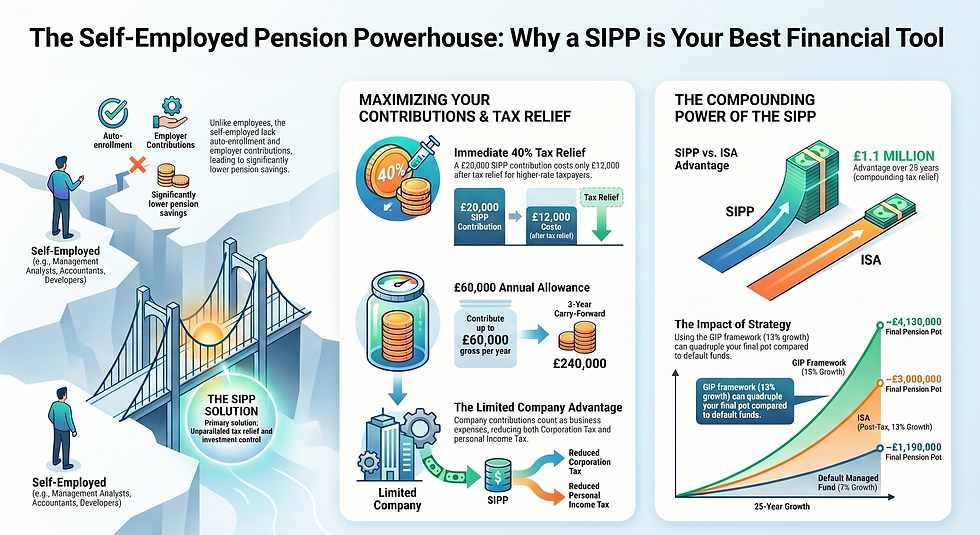
The top ten large-growth mutual funds had average tax drag of 6.7% in 2023; comparable ETFs had tax drag of 0.4%. Maximise your ISA (£20,000 per year) and SIPP annual allowances before investing in taxable accounts. Every pound inside a tax wrapper is a pound shielded from tax drag.
12. Liquidity Risk: Can You Actually Sell What You Own?
Liquidity risk is the danger that an investment cannot be sold quickly at a fair price when you need to exit. Acharya and Pedersen quantified the liquidity premium at approximately 4.6% for equities in their 2005 paper—real compensation for real risk.
Neil Woodford's fund was a £3.5 billion lesson: investors who had been sold the fund as accessible could not exit for over a year from 2019.
During March 2020, even US Treasury bond ETFs experienced abnormal illiquidity. The GIP framework focuses on liquid, exchange-listed instruments held in tax wrappers—investments you own, understand, and can exit.
13. Trading Costs and Execution: The Invisible Fee
Commission-free trading platforms did not eliminate trading costs; they shifted them. Payment for order flow, bid-ask spreads, and execution quality variations mean every trade still has a price; it is just less visible.
A UC Irvine study executing 85,000 trades in 2022 found execution quality varied dramatically by broker, costing retail investors an estimated $34 billion annually across US markets.
Infrequent traders in a Heliyon 2021 dataset earned 18.5% per annum; frequent traders in the same market earned 11.4%. The trading itself was the drag, not the individual decisions.
14. Risk-Adjusted Returns: Raw Returns Do Not Tell the Full Story
A portfolio that returned 15% last year by taking on enormous volatility is not necessarily better than one that returned 12% with minimal volatility.
The Sharpe Ratio divides excess return above the risk-free rate by the standard deviation of returns—a Sharpe of 1.0 is generally considered good; above 2.0 is exceptional and rare. The Sortino Ratio only penalises downside volatility, not upside.
The Great Investments Programme uses the Sortino as one of its five core metrics because it rewards consistency: a company delivering steady, upward returns scores well; a company that swings wildly does not, even if its average return looks similar.
15. Base Rate Neglect: Your Stock Pick Is Probably Not the Exception
Approximately 40% of all stocks in the Russell 3000 have lost more than 70% of their value and never recovered, according to JP Morgan research. That is the base rate across the entire universe.
Yet retail investors consistently believe their selections will be the exception because the specific story feels compelling. Kahneman and Tversky called this the representativeness heuristic in 1974: we evaluate probability based on resemblance to our mental prototype of success, not on statistical base rates. Barber and Odean confirmed in 2001 that retail investors who trade the most overestimate their edge the most.
Around 92% of active funds underperform their benchmark over twenty years. The practical correction is to treat your portfolio as your own mini-index—a collection of quality companies selected by a systematic, evidence-based process, held through market cycles, and evaluated on risk-adjusted returns. That is exactly what the Great Investments Programme is built to help you do.
Watch: The Great Investments Programme Explained
Download the Full 22-Page Research Guide
The complete guide covers all 15 concepts with worked examples, key formulae, academic citations, and the full twelve-question self-assessment quiz. It cross-references peer-reviewed research from NBER, ScienceDirect, and SSRN, plus institutional research from Dimensional Fund Advisors, T. Rowe Price, and Capital Group.
Frequently Asked Questions
What finance concepts do most UK investors never learn?
Academic research identifies compounding, survivorship bias, sequence of returns risk, tax drag, behavioural biases, fat tails, mean reversion, the Kelly Criterion, liquidity risk, and risk-adjusted returns as the concepts most consistently absent from retail investor knowledge—yet most predictive of long-term outcomes.
Should I prioritise ISA or SIPP for tax efficiency as a UK investor in 2026?
In most cases, a SIPP delivers the higher tax benefit for working-age investors because contributions receive upfront relief at your marginal rate (20%, 40%, or 45%). An ISA grows tax-free but without upfront relief. The right answer depends on your current tax rate, your expected rate in retirement, and whether you need access before age 57.
What is sequence of returns risk and why does it matter for UK pension drawdown?
Sequence of returns risk is the danger that poor investment returns in the first years of drawing down your pension permanently impair your portfolio—even if markets recover strongly afterwards. Two retirees with identical average returns can end up with dramatically different outcomes purely because of the order returns arrive in. A cash buffer to avoid forced selling during market falls is the simplest protection.
How does survivorship bias distort fund manager performance figures?
Survivorship bias means performance data only includes funds that still exist today. It excludes the 30.5% of US equity mutual funds that closed between 1991 and 2020, mostly due to poor performance. Dimensional Fund Advisors found this overstates median fund alpha by approximately 50%.
Is the Sharpe ratio or Sortino ratio better for a UK investment portfolio?
The Sortino ratio is generally more useful because it only penalises downside volatility. The Great Investments Programme uses it as one of its five core metrics because it gives a more honest picture of whether a company is delivering consistent, quality returns.
What is tax drag and how much does it cost UK investors who trade frequently?
Tax drag is the cost from capital gains tax realised during the investment period. Chicago Partners shows an investor paying 20% CGT annually needs to earn approximately 1.9% extra per year just to match an investor who holds and defers. Over thirty years, the difference can run to hundreds of thousands of pounds.
About the Author
Alpesh Patel OBE is a hedge fund manager, author of eighteen books on investing, and a former Bloomberg TV and Financial Times commentator. He was a Visiting Fellow at Corpus Christi College, Oxford, and has provided commentary to the US Congress on financial markets.
He created the Great Investments Programme to give retail investors the same quantitative framework used by professional fund managers—without the jargon and without the conflicts of interest.
This post is produced for educational purposes by the Great Investments Programme. It does not constitute financial guidance personalised to your circumstances. All investments carry risk. Past performance is not a reliable indicator of future results. Tax treatment depends on individual circumstances and may change. Always consult a suitably qualified professional before making investment decisions.


Comments