
The Self-Employed Pension Guide 2026: Why a SIPP Is Your Most Powerful Financial Tool

Updated: Apr 25

If you are self-employed, no one is building your pension for you. There is no employer contributing 3%, 5%, or 10% of your salary. There is no auto-enrolment quietly setting aside money every month. Your retirement provision is entirely the sum of the deliberate decisions you make or don’t make over your working life.
According to HMRC and DWP data, self-employed workers in the UK have significantly lower pension savings than employees at every age bracket. This is not primarily because self-employed people earn less many earn considerably more than the average employee. It is because the structure of auto-enrolment and employer contributions that quietly builds pension wealth for employees simply does not exist for the self-employed.
Alpesh Patel OBE is a hedge fund manager, Bloomberg TV alumnus, Financial Times author, and former Visiting Fellow at Corpus Christi College, Oxford. A significant proportion of GIP members are self-employed business owners, contractors, and consultants.
Why the SIPP Is the Self-Employed Investor’s Most Powerful Financial Tool
The Self-Invested Personal Pension (SIPP) is specifically designed for self-directed investors. You choose the platform. You select the investments. You control the contribution timing. And every pound you put in receives tax relief at your marginal rate making the SIPP the most efficient savings vehicle available to the self-employed.
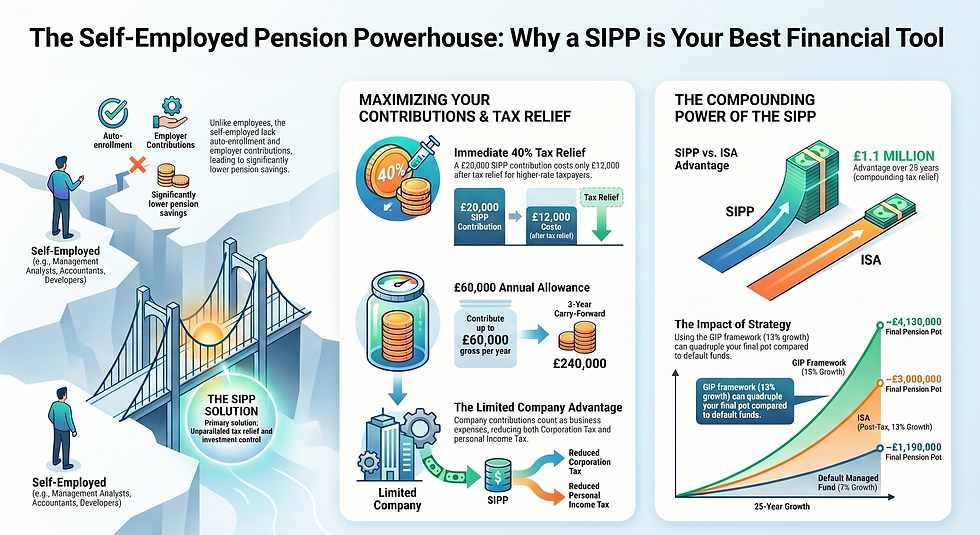
For a self-employed person with £60,000 net profit, contributing £20,000 to a SIPP reduces their taxable income to £40,000. At 40% tax relief on the contribution, the real cost of the £20,000 SIPP contribution is £12,000 after tax. The £8,000 tax saving compounds inside the SIPP alongside the full £20,000 contribution. No other investment vehicle offers this kind of upfront guaranteed return.
How Much Can Self-Employed People Pay Into a SIPP?
Annual allowance: up to £60,000 gross per year (2026/27), or 100% of relevant UK earnings if lower. For sole traders, relevant earnings is net profit. For limited company directors, salary is the relevant earnings but the company can also make employer contributions directly into your SIPP.
Limited company directors: the company can make employer contributions directly to your SIPP as a business expense. These reduce your corporation tax bill as well as your personal income tax. A limited company director contributing £60,000 via employer contributions saves corporation tax at 25% on the contribution AND avoids income tax and National Insurance on that income.
Carry-forward: unused allowance from the previous three tax years can be carried forward and used in a single year, up to £240,000 gross (subject to earnings). For self-employed investors who have had variable income years, carry-forward is particularly valuable.
The Compounding Numbers: What Regular SIPP Contributions Become
A self-employed investor at 40 contributing £1,500/month gross (£900/month net after 40% tax relief) for 25 years:
At 7% (default managed fund): final pot approximately £1,190,000
At 13% (GIP framework): final pot approximately £4,130,000
The £900/month net cost to the investor (after 40% tax relief) produces £4.1 million over 25 years at 13% growth. The same £900/month invested outside a pension, with no tax relief, in an ISA at 13%, produces approximately £3.0 million. The SIPP advantage over the ISA, just from the upfront tax relief compounding over 25 years, is over £1.1 million.
The Three SIPP Platforms Best Suited to Self-Employed Investors
Fidelity: low FX rate (0.25%), low dealing commission (£1.50), good fund range. Best for active international stock-pickers making regular contributions.
Interactive Investor: flat monthly fee (£11.99/month). Best for larger SIPP pots (£50,000+) with infrequent trading. The flat fee advantage grows as the pot grows.
Trading 212: zero platform fee, zero dealing commission, 0.15% FX. Best for cost-focused self-directed investors making regular, smaller contributions across international stocks.
For a personalised self-employed pension assessment including contribution strategy, platform selection, and how the GIP framework applies to your SIPP - book a free portfolio review here
Sources & Further Reading
HMRC — Pension contributions for self-employed people: how much you can pay in and claim tax relief. gov.uk
ONS / DWP — Self-employed pension participation rates and retirement savings gap. ons.gov.uk
MoneyHelper — Pensions for self-employed people. moneyhelper.org.uk
Disclaimer: This article is for educational purposes only. Tax rules are subject to change. All projections are illustrative. This does not constitute personal financial or tax guidance. Always verify current rules with HMRC or a qualified professional.
Alpesh Patel OBE



TN88 khiến tôi quan tâm đến cách nền tảng trình bày thông tin dành cho người theo dõi các sự kiện thể thao. Tôi xem xét cách sắp xếp lịch thi đấu, dữ liệu trận đấu và tỷ lệ để đánh giá khả năng đọc hiểu. Bên cạnh đó, các khu vực nổ hũ, xổ số và game bài được phân chia riêng, tạo điều kiện nhận diện nội dung theo nhu cầu. Tôi cũng chú ý đến cách chuyển đổi giữa các danh mục và khả năng quay lại trang trước mà không mất phương hướng. Theo tôi, giao diện thể thao cần ưu tiên thông tin quan trọng, hạn chế chi tiết dư thừa và sử dụng tiêu đề…
mm 88 giúp tôi đánh giá khả năng nhận diện danh mục thông qua cách sử dụng tên gọi và hình ảnh đại diện. Tôi quan sát trang chủ trước, sau đó chuyển qua Bắn cá, Game bài và Xổ số để xem mỗi khu vực có được trình bày riêng biệt hay không. Tôi cũng chú ý đến vị trí các nút điều hướng và cách giao diện thể hiện đường dẫn khi chuyển từ trang này sang trang khác. Bên cạnh nội dung trò chơi, những thông tin liên quan đến tài khoản và quy định sử dụng cũng cần được bố trí dễ tìm. Qua quá trình trải nghiệm, tôi nhận thấy khả năng phân loại hợp lý…
https://mm88.baby/ khiến mình quan tâm đến cách phần đăng ký được tích hợp vào cấu trúc chung thay vì đứng tách khỏi trải nghiệm trên trang. Những trường như tên tài khoản và số điện thoại được sắp theo một quy trình, còn mã xác thực bổ sung thêm bước hoàn thiện thông tin. Khi khảo sát phần này, mình chủ yếu xem cách từng thành phần được trình bày để người mới hiểu thứ tự cần thực hiện mà không phải đọc quá nhiều hướng dẫn. Một hệ sinh thái dễ tiếp cận theo mình cần cả nội dung lẫn chức năng tài khoản có cấu trúc rõ. Qua cách bố trí hiện tại, mình cảm thấy phần khởi tạo…
https://f8bet0.life/ gợi cho tôi cách đánh giá hệ thống thông qua sự khác biệt giữa danh mục và thông tin chi tiết. Trang giới thiệu nhiều khu giải trí, nhưng mỗi nhóm có cơ chế riêng cần được trình bày rõ. Tôi đọc phần thể thao, casino, game bài, bắn cá và xổ số để xem quy tắc, hạn mức và điều kiện có được nhắc đến đầy đủ. Khi thông tin chỉ dừng ở tên sản phẩm, tôi chưa thể đưa ra kết luận về trải nghiệm thực tế. Phần điều hướng giúp nhận biết chủ đề ban đầu, còn những dữ liệu như luật chơi, thời điểm đóng cược và cách xác định kết quả cần được kiểm tra…
Luck8 khiến tôi quan tâm đến cách những trò chơi có cơ chế vận hành khác nhau được mô tả trong khu vực Nổ hũ. Tôi thường bắt đầu từ các biểu tượng Wild và Scatter, sau đó tìm hiểu thông tin về vòng quay miễn phí và giải độc đắc để xem phần giới thiệu có phân biệt rõ từng khái niệm hay không. Tiếp theo, tôi chuyển sang Bắn cá nhằm so sánh cách trình bày giữa trò chơi sử dụng vòng quay và hình thức chọn mục tiêu liên tục. Điều tôi chú ý là những thuật ngữ chuyên môn có được giải thích bằng ngôn ngữ dễ hiểu cho người mới. Tôi cũng quan tâm đến vị…