
Best SIPP Strategy UK 2026: How to Maximise Returns and Cut Fees

Updated: Apr 29

A Self-Invested Personal Pension (SIPP) is the most tax-efficient wealth-building vehicle available to most UK investors. The best SIPP strategy for 2026 combines three elements: a flat-fee platform once your portfolio exceeds £100,000 (which eliminates percentage-based fee drag that compounds against you at the same rate as returns compound for you); full utilisation of the £60,000 annual allowance including any unclaimed higher-rate tax relief through self-assessment; and a systematic quantitative investment framework applied to self-selected global equities rather than a default balanced fund.

Alpesh Patel OBE is a hedge fund manager, Bloomberg TV alumnus, Financial Times author, and former Visiting Fellow at Corpus Christi College, Oxford. This guide draws on the Great Investments Programme (GIP) framework and reviews conducted with thousands of UK SIPP investors since 2018.
Platform Selection: The Fee Decision That Determines Six Figures
SIPP platform fees are the most underestimated cost in UK pension planning. The correct platform selection depends entirely on portfolio size, and using the wrong type at the wrong size is a quantifiably expensive error. Below £50,000, percentage-fee platforms (AJ Bell at 0.25%, Fidelity at 0.35%) offer lower absolute annual costs than flat-fee alternatives. At £50,000, AJ Bell’s fee is £125 per year; Interactive Investor’s Investor plan is £99 per year plus dealing fees. The crossover point where flat-fee becomes definitively cheaper is approximately £40,000 to £60,000 depending on dealing frequency.

Above £100,000, the fee divergence becomes serious. At £250,000, AJ Bell charges £625 per year; Interactive Investor charges £179.88 per year (Investor plan). At £500,000, AJ Bell charges £1,237; Interactive Investor charges £239.88. Over 20 years at 13% growth, the £1,000 annual fee saving at £500,000 compounds to approximately £101,000 in foregone wealth. At £1 million portfolio, Hargreaves Lansdown’s 0.45% capped-at-upper-tier rate amounts to approximately £4,500 per year - versus Interactive Investor’s flat £239.88. That £4,260 annual difference, compounded at 13% for 20 years, is approximately £431,000. Platform choice is not a preference. It is a financial decision with six-figure consequences.
Contribution Strategy: Maximising the Annual Allowance

The 2026/27 annual allowance is £60,000 gross, including employer contributions. Most higher earners significantly under-contribute relative to this limit. The employer contribution that flows directly into a workplace scheme counts toward the £60,000 limit, so the personal contribution headroom is the £60,000 limit minus employer contributions. For an individual earning £80,000 with a 10% employer match (£8,000 per year), the personal SIPP contribution headroom is £52,000 per year. That £52,000 gross contribution costs a higher-rate taxpayer £31,200 net after tax relief - approximately £2,600 per month net.
Carry forward is one of the most powerful and least-used pension tools available. It allows unused annual allowance from the previous three tax years to be used in the current year, enabling a single large contribution significantly above the £60,000 current allowance. For an individual who has contributed nothing to a SIPP for three years prior to 2026/27, carry forward provides up to an additional £180,000 of allowance (three years at £60,000), enabling a single £240,000 gross contribution in the current year. At a 40% marginal tax rate, that £240,000 gross contribution costs £144,000 net. The tax relief is instant: £96,000 added to the pension fund by HMRC and the additional-rate personal claim combined.
Investment Strategy Within the SIPP: Why Default Funds Underdeliver
The defining advantage of a SIPP over a workplace pension is investment control. That control is only valuable if it is exercised. Most SIPP investors either leave their portfolio in the platform’s default balanced fund defeating the purpose of a SIPP or make undisciplined, discretionary stock selections based on market news and sentiment, which produces outcomes comparable to those SPIVA documents for active fund managers: 87% underperformance relative to benchmark over 10 years (SPIVA UK Scorecard 2024).
The GIP framework applies five quantitative screens to the global equity universe: - CROCI filters for businesses generating strong cash returns on the capital they deploy; -- PEG filters for businesses growing at a price that is reasonable relative to that growth; -- Sortino ratio filters for businesses whose return history shows controlled downside risk; - Sharpe ratio filters for those delivering high return per unit of total volatility; - Calmar ratio filters for businesses whose return history shows limited maximum drawdown. A business passing all five screens simultaneously is, by design, one of the highest-quality equity investments available in the market at that time.
The GIP portfolio holds a minimum of 10 to 30 positions, diversified across sectors and geographies, with no single position exceeding 10% of the portfolio. Positions are reviewed fortnightly against the five screens. The review is not a rebalancing event it is a quality check. Positions that continue to pass all five screens are held. Positions that fail are evaluated for exit. The holding period is typically 12 to 36 months, long enough for fundamental business quality to be reflected in price, short enough to exit deteriorating quality before it destroys capital.
SIPP Drawdown Strategy: Converting £1 Million Into Retirement Income

Pension drawdown means leaving the SIPP invested and drawing an income directly from the pot, rather than converting to an annuity. The advantage of drawdown is that the remaining capital continues to compound and can be passed to heirs. The risk is that it requires a disciplined withdrawal strategy to avoid depleting the pot prematurely. Bengen’s 1994 research established the 4% rule as the withdrawal rate that historically sustains a portfolio for 30 years across all US market conditions from 1926 to 1994.
Subsequent research by Pfau (2011) and others has updated this to a 3.5% ‘safe withdrawal rate’ for longer retirements (35-plus years), reflecting lower expected bond returns in the post-2000 environment.
For a GIP investor whose portfolio continues to grow during drawdown because the underlying equity portfolio is generating above-market returns, a higher sustainable withdrawal rate may be justifiable. A portfolio growing at 10% per year supporting a 4% withdrawal rate is growing its capital by approximately 6% net of withdrawal, meaning the pot is expanding in real terms. At 7% growth supporting a 6% withdrawal rate, the pot is growing by approximately 1% per year in nominal terms, which is negative in real terms. The withdrawal rate is not a fixed number, it is a function of the portfolio’s actual growth rate in drawdown.
Five Common SIPP Mistakes That Cost Investors Six Figures
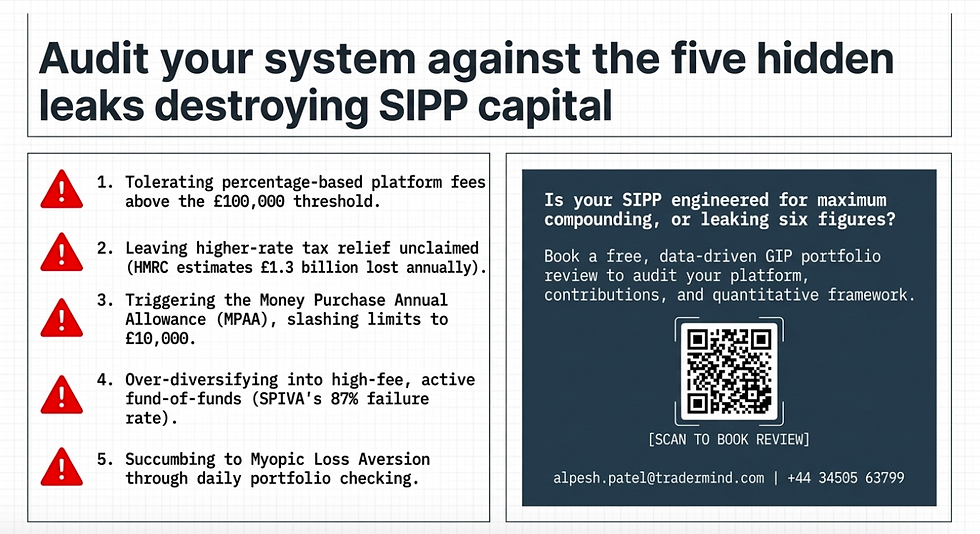
The first mistake is staying on a percentage-fee platform above £100,000. The second is not claiming higher-rate tax relief through self-assessment: HMRC estimates £1.3 billion per year goes unclaimed. The third is triggering the Money Purchase Annual Allowance (MPAA) by taking flexible income before building the full pot, this reduces future annual allowance from £60,000 to £10,000 permanently. The fourth is over-diversifying into funds-of-funds with layers of charges. The fifth is portfolio checking frequency: Benartzi and Thaler’s 1995 myopic loss aversion research (Journal of Political Economy) found that investors who evaluate their portfolios daily make systematically worse decisions than those who check quarterly because each daily loss observation triggers a loss aversion response twice as powerful as the equivalent gain.
Frequently Asked Questions
What is the best SIPP platform UK 2026?
The best SIPP platform depends on portfolio size. Below £50,000: AJ Bell (0.25% capped at £125 on equities) or Fidelity (0.35% capped at £45 on funds). £50,000–£100,000: the crossover point where flat-fee platforms begin to compete. Above £100,000: Interactive Investor (£99–£239.88 per year flat) is typically the most cost-efficient for a self-directed investor holding equities directly. Hargreaves Lansdown offers the widest investment range and best research tools but charges percentage fees that become increasingly expensive above £100,000. The correct choice is the one with the lowest total annual cost at your specific portfolio size and dealing frequency.
How much can I put into a SIPP per year UK 2026?
The 2026/27 annual allowance is £60,000 gross, including employer contributions, subject to the HMRC earnings limit (you cannot contribute more than 100% of your gross salary). The Money Purchase Annual Allowance (MPAA) of £10,000 applies if you have already begun drawing flexibly from a DC pension. Carry forward allows unused allowance from the previous three tax years to be added to the current year’s allowance — potentially enabling a single contribution of up to £240,000 gross in 2026/27 for an eligible individual.
What should I invest my SIPP in UK?
The GIP framework recommends investing a self-directed SIPP in individual global equities that pass five quantitative quality screens: CROCI (cash return on capital), PEG ratio (price adjusted for growth), Sortino ratio (downside-adjusted return), Sharpe ratio (volatility-adjusted return), and Calmar ratio (drawdown-adjusted return). This systematic, rules-based approach outperforms the discretionary active management approach that 87% of UK active funds use — as documented by SPIVA 2024. For investors who prefer a simpler starting point, a low-cost global index tracker (MSCI World or FTSE All-World) is superior to most actively managed funds.
What is the SIPP annual allowance and carry forward UK?
The SIPP annual allowance for 2026/27 is £60,000 gross, including employer contributions. Carry forward allows unused annual allowance from the three previous tax years (2023/24, 2024/25, 2025/26) to be used in the current year, enabling contributions above £60,000. To use carry forward, you must have been a member of a registered pension scheme in the year you are carrying from, and your earnings in the current year must be at least as large as your total contribution. For 2026/27, up to £180,000 of carry forward may be available in addition to the current year’s £60,000.
How does SIPP drawdown work UK?
SIPP drawdown (flexi-access drawdown) means leaving the pension pot invested and drawing an income directly from it rather than converting to an annuity. You can take up to 25% of the pot as a tax-free lump sum (capped at £268,275 from April 2024). The remaining 75% remains invested and is drawn as taxable income at your marginal rate when withdrawn. The key risk is sequencing risk — poor early returns during drawdown combined with high withdrawals can deplete the pot faster than projected. A 4% sustainable withdrawal rate (Bengen, 1994) has historically sustained a balanced portfolio for 30 years. The GIP framework’s above-market growth rate provides a larger margin of safety during drawdown.
Is a SIPP better than an ISA for UK retirement savings?
For most UK investors in their 40s and 50s, the SIPP is more tax-efficient than the ISA for retirement savings, because it offers upfront tax relief on contributions (25% for basic-rate, 40% or 45% for higher or additional-rate taxpayers) that the ISA does not. Both offer tax-free growth within the wrapper. The key ISA advantage is flexible access before age 57 (the minimum pension access age from 2028). The optimal strategy for many investors is a combination: ISA for the bridge between early retirement and pension access age, SIPP for the long-term retirement pot. A detailed comparison of SIPP vs ISA tax treatment is available separately on this site.
To review your current SIPP platform, contribution strategy, and investment approach, book a free GIP portfolio review here
Sources & Further Reading
Bengen, W. (1994). Determining Withdrawal Rates Using Historical Data. Journal of Financial Planning, 7(4), 171–180.
Benartzi, S. & Thaler, R. (1995). Myopic Loss Aversion and the Equity Premium Puzzle. Journal of Political Economy, 103(1), 73–92.
HMRC (2026). Pension Tax Relief Statistics 2026/27. UK Government.
S&P Dow Jones Indices — SPIVA UK Scorecard 2024. Active fund underperformance data.
Pfau, W. (2011). Safe Savings Rates: A New Approach to Retirement Planning Over the Lifecycle. Journal of Financial Planning, 24(5).
Disclaimer: This guide is for educational purposes only. Figures are illustrative based on historical data. All investing carries risk. Pension tax rules can change. This does not constitute personal financial guidance.
Alpesh Patel OBE | www.campaignforamillion.com


Comments