
Trading 212 SIPP Review 2026: The Zero-Commission Platform Serious Investors Should Know About

Updated: Apr 14

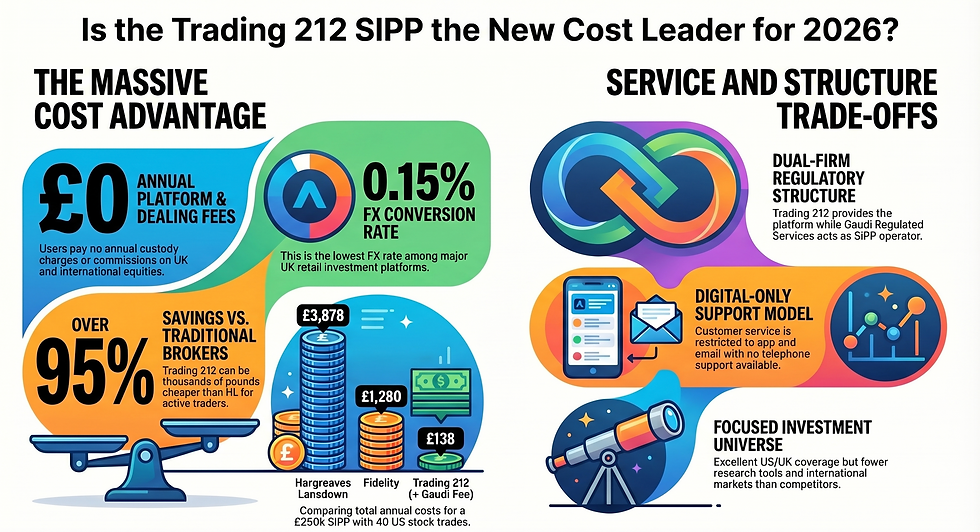
Trading 212 has built one of the most cost-competitive SIPP offerings in the UK market. Zero dealing commission. Zero annual platform fee. FX conversion at 0.15%. On pure cost grounds, it is the cheapest mainstream platform available to UK self-directed investors.
Trading 212 is primarily known as a retail trading app — the platform that brought zero-commission investing to the UK mass market and has over 3.5 million registered users. Its SIPP product, launched more recently, is operated via a partnership with Gaudi Regulated Services, an FCA-authorised SIPP operator.
This structure is different from HL, AJ Bell, and Fidelity, where the platform itself is the SIPP operator. It is worth understanding exactly how it works before making a transfer decision.
Alpesh Patel OBE is a hedge fund manager, Bloomberg TV alumnus, Financial Times author, and former Visiting Fellow at Corpus Christi College, Oxford. The cost structure of trading platforms is a recurring topic in GIP portfolio reviews — and Trading 212 has become an increasingly relevant option as its SIPP offering matures.
Trading 212 SIPP Charges: The Full Picture
Platform fee: £0 per year. No annual custody or administration charge on the SIPP wrapper.
Dealing commission: £0 per trade. Zero commission on UK and international equities and ETFs. No minimum trade size.
FX conversion: 0.15%. The lowest FX rate of any major UK retail platform. On a £10,000 US stock purchase: £15 in FX vs £100 on HL.
Gaudi SIPP operator fee: a small annual administration fee charged by Gaudi as the FCA-authorised SIPP trustee. As at March 2026, this is approximately £75–£100 per year for active SIPPs. Always verify the current Gaudi fee structure directly before opening.

Even with the Gaudi fee included, Trading 212’s all-in annual cost is dramatically lower than HL, AJ Bell, or Fidelity for active traders. For a £250,000 SIPP making 40 US stock trades per year at £8,000 average:
HL: £200 platform + £478 dealing + £3,200 FX = £3,878/yr
Fidelity: £180 platform + £300 dealing + £800 FX = £1,280/yr
Trading 212 + Gaudi: £90 Gaudi + £0 dealing + £48 FX = £138/yr
IBKR: £250 platform + £68 dealing + £32 FX = £350/yr
For a frequent trader buying US stocks, Trading 212 is materially cheaper than even IBKR the previous benchmark for low-cost US equity investing in a UK SIPP. The saving vs HL of approximately £3,740 per year on this profile is substantial and compounds significantly over time.
The Custody Model: How Trading 212 Holds Your Assets
Trading 212 operates as a trading platform; Gaudi Regulated Services is the FCA-authorised SIPP operator and holds the pension wrapper. Assets within the SIPP are held by Trading 212 as the custodian under FCA client asset rules (CASS). This means your investments are segregated from Trading 212’s own assets.
FSCS protection applies to the SIPP wrapper via Gaudi (up to £85,000 as a regulated pension operator) and to the investment platform via Trading 212 Markets Ltd (up to £85,000 as an FCA-authorised investment firm). FSCS protection on Trading 212 covers the value of investments in the event of firm failure, not market losses. Shares held in a SIPP are CASS-protected client assets and would be returned to clients in an insolvency event even if not covered by FSCS.
Where Trading 212 Falls Short

Trading 212’s SIPP is newer than HL, AJ Bell, and Fidelity’s equivalents, and there are meaningful differences in the platform experience. Customer service is app and email-based — there is no telephone support, which will matter to some investors. Research and analytical tools are more limited than HL. The platform universe covers most major US and UK equities but is less comprehensive than HL or Fidelity for international markets beyond the US. The SIPP transfer experience — bringing in pots from other providers — has historically been slower than HL for some transfers.
The Verdict: Who Should Use Trading 212 for a SIPP?

Trading 212 is most compelling for GIP investors who trade frequently in US stocks, are comfortable with a digital-only service model, have verified the universe of stocks they need is available on the platform, and are happy to work with the Gaudi partnership structure rather than a single integrated SIPP operator. The pure cost advantage is real and very significant for active portfolios.
For investors who value telephone customer service, want the most comprehensive research tools, or manage a portfolio with significant exposure to less liquid international markets beyond the US, HL or Fidelity remains a better fit. The cost difference is meaningful but service quality still has genuine value for certain investor profiles.
Frequently Asked Questions: Trading 212 SIPP
Is Trading 212 SIPP safe?
Trading 212 Markets Ltd is FCA-authorised. Gaudi Regulated Services, the SIPP operator, is also FCA-authorised and regulated by The Pensions Regulator. Client assets are held under FCA CASS rules, segregated from Trading 212’s own assets. FSCS protection applies up to £85,000 on the investment platform. The Gaudi partnership structure is a legitimate and used model in the UK SIPP market — other fintechs use similar white-label SIPP operator arrangements.
Can I transfer an existing pension to Trading 212?
Yes. Trading 212’s SIPP accepts transfers from existing defined contribution pension schemes and SIPPs. The transfer process is managed through the Trading 212 app. Transfer timelines have varied — check recent user experience and confirm directly with Trading 212 before initiating a transfer of a large pot. Always verify that the stocks you intend to hold are available on the platform before transferring.
What stocks can I hold in a Trading 212 SIPP?
Trading 212’s SIPP covers a wide range of UK and US-listed equities and ETFs. The universe covers the majority of stocks on the GIP Approved List. However, it does not offer the same breadth as HL or Fidelity for European, Asian, and emerging market exchanges. Before transferring, search for the specific stocks you intend to hold and confirm availability on the platform.
How does Trading 212 make money if it charges zero commission?
Trading 212 generates revenue primarily through: FX conversion fees (0.15% on currency conversions), interest on uninvested cash held in client accounts, payment for order flow on certain trade executions (disclosed in their order execution policy), and premium subscription features. The FX margin and cash interest are the primary revenue drivers. Zero commission does not mean zero economics for the platform — it means the revenue model is structured differently from traditional commission-based brokers.
Should I switch from HL to Trading 212 SIPP?
Run the cost comparison for your specific portfolio and trading pattern. If you make 20+ US stock trades per year, the annual saving vs HL is very material — potentially £1,500–3,000 depending on trade size and frequency. If you rarely trade and value HL’s service and research tools, the saving is less compelling. The key questions are: are all your target stocks available on Trading 212? Are you comfortable with a digital-only service model? Are you satisfied with the Gaudi custody structure? If yes to all three, the cost case is strong.
For a platform assessment tailored to your specific portfolio size and trading frequency, book a free portfolio review here.
Sources & Further Reading
Trading 212 — SIPP product page, charges, FX rates, and custody information. trading212.com/sipp
Gaudi Regulated Services — FCA-authorised SIPP operator. SIPP trustee for Trading 212’s pension product. gaudiregulated.com
Financial Conduct Authority — Trading 212 Markets Ltd FCA register entry. Confirms authorisation status. register.fca.org.uk
Good Money Guide — Trading 212 review and SIPP platform comparison 2026. goodmoneyguide.com
Disclaimer: This article is for educational purposes only. Fee figures are based on publicly available Trading 212 pricing as at March 2026 and are subject to change. Always verify current charges, available stocks, and custody arrangements directly with Trading 212 and Gaudi before making any transfer decision.
Alpesh Patel OBE



Comments