
Fidelity SIPP Review 2026: A Serious Platform for Serious Investors?

Updated: 1 day ago
Fidelity SIPP: what to check first. Compare the platform fee, investment charges, dealing costs and currency conversion for the investments you actually hold. Then check the available investments and retirement options. This guide explains those checks; verify current prices with Fidelity before opening or transferring a pension.

Fidelity is one of the most underrated retail SIPP platforms in the UK. Among serious self-directed investors — particularly those with meaningful exposure to US-listed stocks — it deserves serious consideration.
Sadly, it soon lets you down.
Fidelity International is one of the world’s largest privately-owned investment managers, with over £700 billion in assets under management globally. In the UK, its retail investment platform — Fidelity Personal Investing — offers ISAs, SIPPs, and investment accounts with access to UK and international equities, funds, ETFs, and investment trusts.
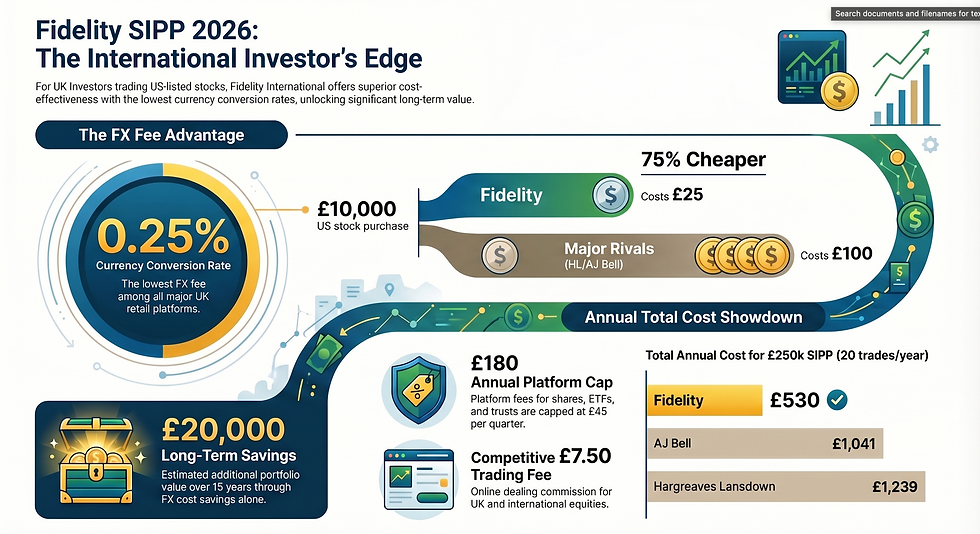
The reason Fidelity belongs in the GIP platform comparison is its FX con
version rate: 0.25% on all currency conversions. This is the lowest of any major UK retail platform — significantly below HL (1.0% up to £5,000), AJ Bell (1.0% up to £10,000), and Interactive Investor (1.5%).
For GIP investors whose Approved List includes 10–15 US-listed stocks and who make quarterly portfolio adjustments, Fidelity’s FX advantage translates to several hundred pounds in annual savings.
Alpesh Patel OBE is a hedge fund manager, Bloomberg TV alumnus, Financial Times author, and former Visiting Fellow at Corpus Christi College, Oxford. The GIP Approved List regularly includes US-listed companies, making FX cost a material consideration in platform selection.
Fidelity SIPP Charges 2026: The Full Breakdown
Fidelity’s SIPP charges for shares and ETFs:
Platform fee: 0.35% on the first £250,000, capped at £45/quarter (£180/year) for shares, investment trusts and ETFs
Dealing commission: £7.50/trade online for UK and international equities (reducing to £1.50 for regular investment orders)
FX conversion: 0.25% on all currency conversions — the lowest of any major UK retail platform
Funds (OEICs): 0.35% on first £250,000, 0.20% on £250,000–£1 million, 0.10% above £1 million — uncapped for funds

The FX Advantage: Why It Matters for GIP Investors
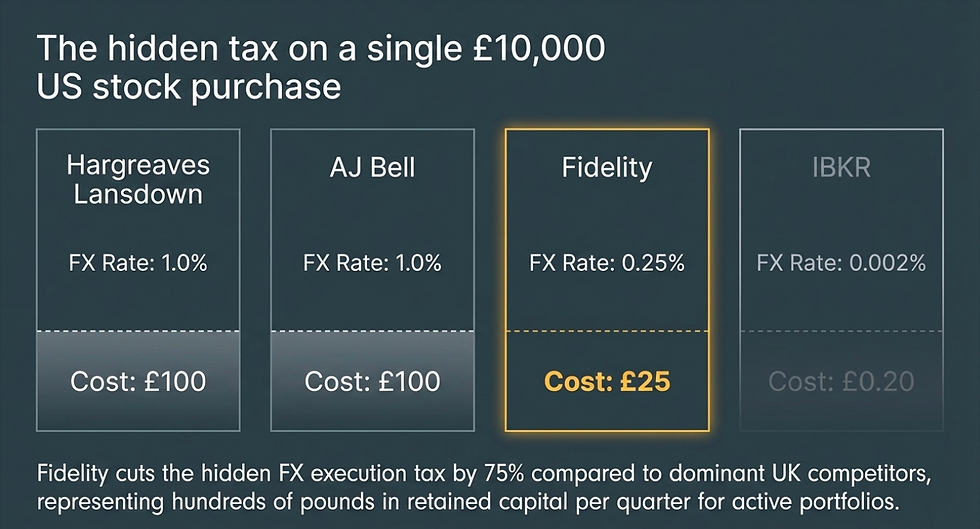
The GIP Approved List regularly includes US-listed companies across technology, healthcare, consumer, and industrial sectors. Buying a £10,000 position in a US stock requires converting sterling to dollars, and the FX rate on that conversion is a real cost that compounds over time.
On a £10,000 US stock purchase:
HL FX cost: 1.0% = £100
AJ Bell FX cost: 1.0% = £100
Fidelity FX cost: 0.25% = £25
IBKR FX cost: 0.002% = £0.20
For a GIP investor making 10 US stock purchases per quarter at £10,000 each, the annual FX saving on Fidelity vs HL is approximately £3,000. Even for a more modest 10 trades per year at £8,000 average, the saving is approximately £600 per year. Compounded over a 15-year investment horizon, that FX saving is worth approximately £20,000 in additional portfolio value.
The Full Four-Platform Comparison for GIP Investors
For a £250,000 SIPP making 20 trades per year (10 UK, 10 US at £8,000 average):
HL: £200 platform + £239 dealing + £800 FX = £1,239/yr
AJ Bell: £42 platform + £199 dealing + £800 FX = £1,041/yr
Fidelity: £180 platform + £150 dealing + £200 FX = £530/yr
IBKR: £250 platform + £34 dealing + £16 FX = £300/yr

For a regular US stock buyer, Fidelity is dramatically cheaper than HL and AJ Bell — saving £709 and £511 per year respectively. Only IBKR is cheaper, and only for investors who are comfortable with a more complex platform. For GIP investors who want competitive costs, a good UK interface, and are regularly buying US stocks, Fidelity is the most compelling option that has not historically received the attention it deserves.
Where Fidelity Falls Short of HL
Fidelity’s primary weakness compared to HL is its research and analytical tools. HL’s research library, fund performance data, portfolio analytics, and mobile app are materially better than Fidelity’s. For investors who rely heavily on HL’s tools as part of their investment process, the FX saving on Fidelity may not justify the switch. Fidelity’s customer service is competent but does not match HL’s speed and depth of response.
For GIP investors who use the GIP Approved List and their own quantitative process rather than the platform’s built-in research tools, this gap is less relevant. The platform’s core function — execution, custody, and reporting — is solid on Fidelity. The FX and dealing cost advantage is real and persistent.

Fidelity also lets you down because it primarily pushes its own funds. And we know funds underperform their benchmarks and the markets over the long term. So they are sucking you in on their brand name but failing to deliver.
This also limits what you can buy and sell on the platform. All in all, you're as caged in as my guinea pigs.
Frequently Asked Questions: Fidelity SIPP
What are Fidelity SIPP charges in 2026?
For shares, ETFs and investment trusts: 0.35% per year, capped at £45/quarter (£180/year). Dealing: £7.50/trade online. FX conversion: 0.25% — the lowest of any major UK retail platform. Funds: 0.35% uncapped up to £250,000. No SIPP setup or drawdown charges for most standard arrangements.
Is Fidelity SIPP safe?
Yes. Fidelity International is FCA-authorised, one of the world’s largest privately-owned asset managers, and subject to FSCS protection up to £85,000. Client assets are held separately from Fidelity’s own balance sheet under FCA custody rules.
Is Fidelity better than Hargreaves Lansdown for a SIPP?
For investors who regularly buy US stocks, Fidelity is substantially cheaper than HL due to its 0.25% FX rate vs HL’s 1.0%. For investors who rely heavily on HL’s research tools and prefer its interface, HL’s service quality may justify the FX premium. For pure cost minimisation with US equity exposure, Fidelity wins over HL clearly at most portfolio sizes.
Can I hold US stocks in a Fidelity SIPP?
Yes. Fidelity provides access to UK and international equities including NYSE and NASDAQ-listed stocks, as well as major European and Asian exchanges. The universe covers the majority of stocks on the GIP Approved List. FX conversion at 0.25% applies for non-GBP purchases.
Does Fidelity have a regular investment option?
Yes. Fidelity offers a regular investment facility at a reduced dealing charge of £1.50 per trade. This is particularly useful for investors making monthly or quarterly contributions to existing positions. Combined with the 0.25% FX rate, Fidelity’s regular investment option makes it highly cost-effective for systematic monthly investment in US stocks.
For a holistic assessment of your current platform against your portfolio size, trading pattern, and the GIP approach, book a free portfolio review here.
Before You Open a Fidelity SIPP: What to Read and What It Really Costs
A self invested personal pension with Fidelity carries three layers of cost, and people usually only look at the first. There are Fidelity's own service fees for holding your account, the charges of each fund or ETF you buy, and dealing costs when you trade shares, ETFs or investment trusts. On shares and investment trusts there is also the bid offer spread, the gap between the price you buy at and the price you could sell at, which never appears on a fee schedule.
Before buying anything, read its key information document or product summary document. It sets out the ongoing charges, the risk score and what the product invests in. Five minutes with that document tells you more than most marketing pages.
The tax case is the same as for any SIPP. Your money grows free of income tax and capital gains tax, which makes it one of the most tax efficient places to invest for retirement. Tax rules can change, and how they apply depends on your personal circumstances, so check the current rules before you make a large contribution or transfer.
Sources & Further Reading
Fidelity Personal Investing — SIPP charges, dealing commissions, FX rates, and platform features (2026). fidelity.co.uk/sipp
Hargreaves Lansdown — SIPP charges and FX rates for comparison. hl.co.uk/pensions/sipp
Financial Times — SIPP platform comparison and FX cost analysis. ft.com/personal-finance
Good Money Guide — Best SIPP providers 2026. Independent platform comparison. goodmoneyguide.com
Times Money Mentor — UK investment platform comparison 2026. thetimes.co.uk/money-mentor
Explore related guides
Disclaimer: This article is for educational purposes only. Fee figures are based on publicly available Fidelity pricing as at March 2026 and are subject to change. This does not constitute a personal recommendation to use any specific platform. Always verify current charges directly with the provider.
Alpesh Patel OBE


Comments