
What Does the Middle East War Mean for the Stock Market?

Updated: Sep 4

The "pause" of 2025—a fragile, twelve-day reprieve—has shattered, replaced by a campaign of strategic opportunism that seeks nothing less than the permanent neutering of Tehran’s regional reach.
For months, the status quo was defined as a "pause, not a peace," a tense breath held while the world waited for the next tremor. That tremor has arrived as a tectonic shift: an unprecedented U.S.-Israeli joint air campaign that has dismantled hundreds of targets across the Iranian heartland.
This is not a mere tactical escalation. It is a fundamental recalibration of the regional order, catalysed by the confirmed death of Supreme Leader Ayatollah Ali Khamenei.
His passing, alongside a significant portion of the regime’s senior leadership, has transformed a military operation into a geopolitical hinge point.

We are no longer observing a quest for leverage at a negotiating table; we are witnessing the terminal phase of the Islamic Republic as a revisionist power.
The central question for 2026 is whether we are living through the most significant regional metamorphosis since the 1979 Revolution. For Washington, the clock was ticking, driven by the realization that its massive military posture was unsustainable.
This "use it or lose it" moment has forced a decisive move, aimed at shattering the brittle remains of a regime already weakened by domestic protest and the decimation of its proxy network.

1. The Death of the Supreme Leader: A Generational Game Changer for the Stock Market
The death of only the second Supreme Leader in the history of the Islamic Republic creates a vacuum that the regime’s ossified structure is ill-equipped to fill.
In a system where the Vali-e-Faqih serves as the ultimate arbiter between competing security and clerical factions, his removal eliminates the core of the state's decision-making apparatus.
Succession is no longer a theoretical exercise; it is a live-fire crisis. Without Khamenei’s presence to mediate the inevitable fissures between the IRGC and the remaining clerical elite, internal fragmentation becomes the state’s most existential threat.

Stock Market Impact of Leadership Vacuums
The risk is no longer just political transition, but a total breakdown of the command-and-control structures that have held Iran together for four decades.
Khamenei’s death creates a generational opening for transformation, but it also raises the risk of internal instability like what we’ve seen in Libya, only on a larger scale.
For investors and the global stock market, such uncertainty can trigger volatility across energy markets, defence stocks, and emerging market capital flows.
2. The “Over to You” Doctrine and the Global Stock Market
This campaign is the antithesis of the 2003 Iraq War. There is no looming ground invasion, no hubristic nation-building syllabus, and no intention for Washington to "own" Iran’s political future.
Instead, the strategy follows a clinical "Over to You" doctrine: strip the regime of its ability to project power—both through its nuclear program and its regional proxies—and then step back.

Why the Stock Market Watches Military Strategy
This reflects a calibrated "no forever wars" approach. By targeting command-and-control hubs, missile facilities, and air defenses, the coalition intends to create a vacuum that the Iranian people themselves must fill.
This is a strategic decoupling; the West provides the kinetic destruction of the regime's "iron fist," leaving the subsequent political architecture to the locals.
For policymakers and the stock market, this doctrine attempts to limit prolonged instability that could otherwise disrupt oil prices and global financial markets.
3. Magazine Depth, China, and the Strategic Implications for the Stock Market
The military reality of this conflict is dictated by "magazine depth" - the brutal arithmetic of how many munitions one side can fire versus how many interceptors the other can field.

Tehran entered this conflict with a rebuilt arsenal of roughly 2,000 ballistic missiles. To counter this, the U.S. has surged THAAD batteries to the region, but these assets are finite.
The timing of this campaign was not accidental. Washington faced a "use it or lose it" window, driven by the unsustainable cost of maintaining a peak military posture and a looming diplomatic deadline: the President’s scheduled trip to China at the end of the month.
The administration cannot afford to be bogged down in a Middle Eastern quagmire while attempting to manage hegemonic competition in the Pacific.
Furthermore, every interceptor expended over the Persian Gulf is an "opportunity cost" for readiness in the Indo-Pacific—a strategic reality that forced a compressed, high-intensity timeline to break Tehran’s back before Western magazines ran dry.
Defence Spending and the Stock Market
These strategic calculations directly influence the stock market, particularly defence contractors, energy companies, and logistics firms that respond quickly to geopolitical escalation.
4. The 65% Probability of a "Messy" Collapse - What It Means for the Stock Market
While we assess a 65% likelihood of regime collapse or irreversible degradation, this transition will be far from orderly. For forty years, the Islamic Republic has ruled through fear, not inspiration.

The regime "still has all the guns," and as we saw during the brutal crackdowns of January, it is willing to use them.
The historical parallels are sobering. The primary risk is a "Libya scenario"—a decade or more of fragmented instability where no single group can assert control.
Even more haunting is the "Saddam 1991" precedent: a scenario where the regime is militarily defeated but survives the initial onslaught, only to pivot and crush the domestic opposition once the U.S. and Israel declare "mission accomplished" and withdraw.
If the IRGC survives the strikes intact, it may seek to install a military-led government, leading to a protracted struggle between the security services and a diffuse, unorganised opposition.

Stock Market Risks in a “Libya Scenario”
The primary risk is a "Libya scenario" a decade or more of fragmented instability where no single group can assert control.
Such instability would inevitably spill over into the stock market, particularly through energy price spikes, shipping disruption, and risk premiums across emerging markets.
5. The Myth of the "CRINK" Axis
The conflict has ruthlessly exposed the limitations of the "CRINK" axis (China, Russia, Iran, North Korea). Despite Tehran’s role as a key revisionist partner, the reactions from Beijing and Moscow have been notably muted.
Their silence sends a chilling message to other secondary powers in the axis: this is a marriage of convenience, not a collective defence pact.
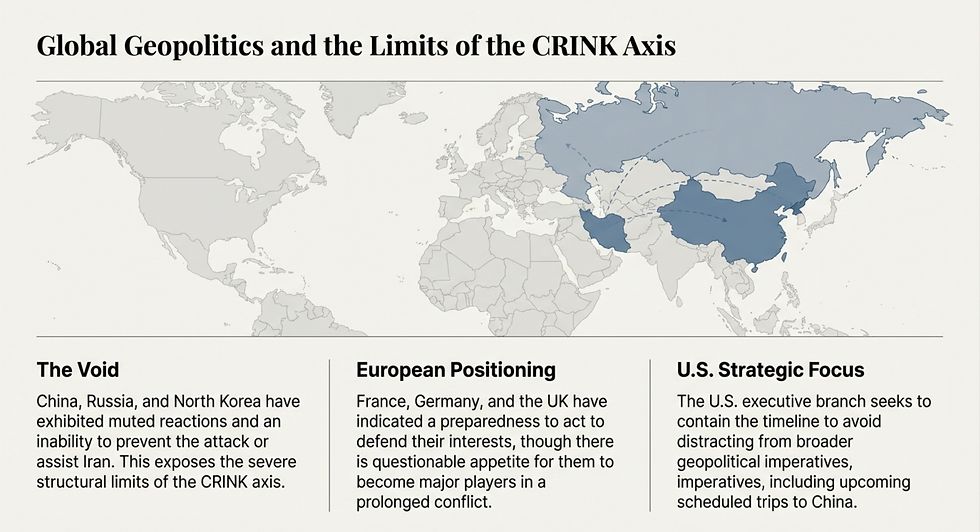
China and Russia’s refusal to provide tangible military aid or meaningful diplomatic cover highlights the limits of their global alignment.
For other states looking to challenge the Western order, the lesson is clear—when the Tomahawks start flying, you are on your own. This abandonment by its primary patrons further accelerates the regime’s internal rot and isolates the IRGC at its most vulnerable hour.
Global Alliances and the Stock Market
China and Russia’s muted response highlights the limits of their alignment.
Financial markets and the stock market interpret such signals quickly, adjusting geopolitical risk premiums and global investment expectations.
6. A Bullish Middle East: The Long-Term Stock Market Opportunity
Despite the near-term carnage, the medium-to-long-term outlook for the Middle East is exceptionally bullish. For decades, the Islamic Republic has acted as the single greatest obstacle to regional integration, functioning as an exporter of instability that placed a ceiling on the growth of its neighbour's.

In the immediate term, the disruption is severe. Iranian drones penetrating Gulf airspace have shattered assumptions about the insulation of commercial hubs like Dubai and Doha. We are seeing real-world impacts on insurance pricing, sovereign risk, and property valuations across the region’s aviation and financial sectors.
However, if Iran is finally neutered, these are merely birth pangs of a new era. Once the threat to the Strait of Hormuz is removed and the proxy networks are dismantled, the Middle East can finally evolve into a truly global hub for technology, finance, and tourism.

With Iran less able to export instability abroad either because it remains mired in internal struggle or a more congenial regime takes charge the Middle East will thrive and integrate further.
A New Regional Growth Story for the Stock Market
Once the threat to the Strait of Hormuz is removed and proxy networks are dismantled, the Middle East could evolve into a major hub for technology, finance, tourism and global stock market investment.
Conclusion: The New Regional Order and the Future of the Stock Market
The events of 2026 mark the end of the era of shadow wars. The strategic balance of the Middle East is being forcibly reset, moving away from four decades of Iranian-driven revisionism toward a conclusion that, while messy, offers the prospect of a more stable, integrated region.
The Iranian people now face the daunting task of determining their own future in the vacuum left by a dying theocracy. As the coalition winds down its strikes to focus on other global priorities, the world must prepare for the consequences of a post-revolutionary Iran.

Is the international community ready for a nation that is finally integrated into the regional fold, or will we simply watch as one form of instability is replaced by another?
For the global stock market, the stakes are enormous: energy security, geopolitical stability, and capital flows into emerging markets all hinge on the outcome.
The era of the Islamic Republic is ending; the era of Iranian uncertainty has just begun and the stock market will be one of the first places where the consequences of this historic shift are reflected.
⚠️ Disclaimer
Capital is at risk. Past performance is not indicative of future results. This article is for educational purposes only and does not constitute personal investment advice. Please do your own research and, if needed, consult a regulated financial adviser.
Alpesh Patel OBE www.campaignforamillion.com


Mình không thuộc dạng đánh theo cảm xúc cho lắm, nhưng cũng chẳng đặt nặng chuyện hên xui. Thường mình hay ngồi xem lại vài kỳ gần đây, ghi chú những nhóm số hay lặp rồi lọc ra mấy con mình thấy hợp mắt để thử vận may. Có hôm trúng được chút thì vui vui, còn hôm nào trật hết thì coi như bỏ, chủ yếu để xả stress sau giờ làm. Mấy bài kiểu dự đoán xổ số miền bắc mình đọc cho biết thôi, nhất là đoạn nói về cầu với thống kê, nghe cũng có lý nếu mình tỉnh táo. Mình tự nhắc là chơi vừa phải, biết dừng đúng lúc kẻo cuốn theo. Thỉnh thoảng…