
Morgan Stanley on the AI Efficiency Paradox: Why the 2026 Workforce Is Shrinking as Productivity Soars

Updated: Mar 21
In 2025, artificial intelligence spending was driven by experimentation and urgency. Companies raced to build infrastructure, adopt models, and signal innovation. By mid-2026, that phase has ended. Boards and investors are no longer impressed by ambition alone. They are asking one question: what is the return?
Alpesh Patel OBE is a hedge fund manager, Bloomberg TV alumnus, Financial Times author, and former Visiting Fellow at Corpus Christi College, Oxford. He analyses global investment research — including Morgan Stanley's key reports — for pension investors and traders at campaignforamillion.com.
According to Morgan Stanley Research, this shift marks the emergence of the AI efficiency paradox; a phase where AI is delivering meaningful productivity gains, while simultaneously reducing global employment. The data signals a structural change in how companies grow, hire, and allocate capital.
This analysis draws on Morgan Stanley's survey of more than 900 global executives across AI-exposed sectors, capturing how AI is now reshaping profit margins, workforce structures, and market valuations.
The AI Efficiency Paradox in Action — Productivity Up, Headcount Down

AI has now moved from experimental technology to a core operational driver.
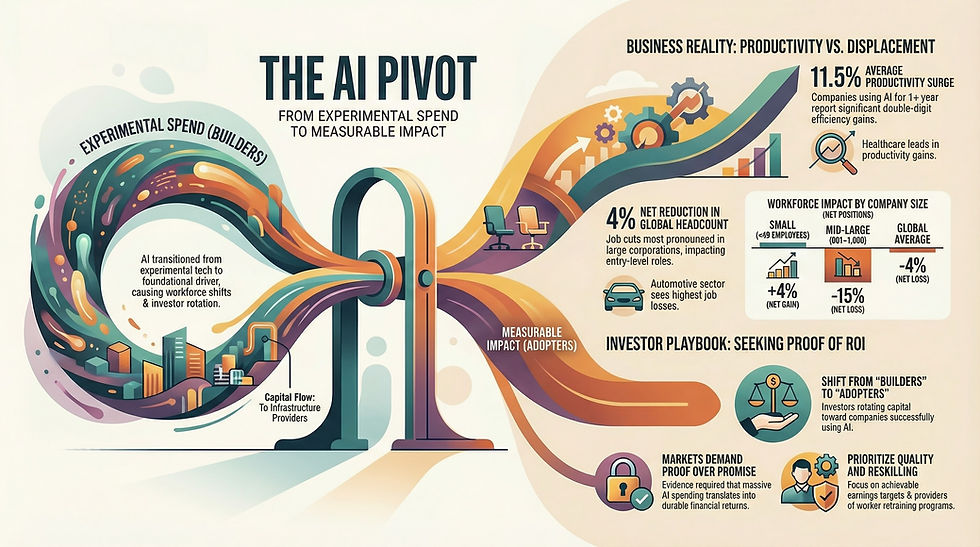
Morgan Stanley Research shows that companies using AI for more than one year are reporting average productivity gains of 11.5%. These efficiency improvements are broad-based and visible across major developed markets, confirming that AI adoption is translating into real operational leverage.
However, the workforce impact tells a different story.
Across five high-exposure sectors — Consumer Staples, Real Estate, Transportation, Healthcare, and Automotive — Morgan Stanley estimates a 4% net reduction in global headcount. While new hiring continues, it is no longer sufficient to offset job eliminations and unfilled roles.
This decoupling of output and employment is the defining feature of the AI efficiency paradox: companies are producing more value with fewer people.
AI Efficiency Paradox #1 — Job Losses Are Real, but Uneven

The employment impact of AI is not evenly distributed.
Morgan Stanley's workforce impact analysis highlights sharp regional divergence. The United States remains a short-term outlier, still showing modest net job growth as hiring temporarily exceeds automation. Europe, by contrast, is already experiencing deeper and more sustained workforce contraction — with the UK seeing 8% net job losses, higher than any other country surveyed.
Sector differences are equally pronounced. Automotive firms show some of the steepest net job losses, while Real Estate has remained comparatively resilient. Importantly, Morgan Stanley cautions that current figures likely represent an early signal rather than the end state.
Even so, the warning is clear: the AI efficiency paradox is already altering employment outcomes faster than many forecasts anticipated.
AI Efficiency Paradox #2 — The Hollowing Out of Entry-Level Roles

One of the most under-appreciated consequences of AI efficiency is its impact on early-career employment.
Morgan Stanley Research indicates that AI adoption disproportionately affects entry-level roles, particularly those involving routine and repetitive tasks. These positions are being eliminated or left unfilled as AI systems absorb foundational work.
Mid-career professionals, typically with two to ten years of experience, are far less exposed. Instead of being replaced, they are being retrained and redeployed to manage AI tools and workflows.
This creates a long-term structural risk. By narrowing the entry-level funnel today, companies may be undermining the future supply of experienced talent. The AI efficiency paradox may solve near-term cost pressures while storing up a skills shortage for the next decade.
AI Efficiency Paradox #3 — Small Firms Are Gaining, Mid-Sized Firms Are Cutting

A common assumption has been that large firms would benefit most from AI due to scale and capital access. Morgan Stanley's data challenges this view.
Small firms with fewer than 50 employees are showing net job gains of approximately 4%. These companies are using AI as a growth enabler — expanding output, reach, and capability without heavy legacy costs.
By contrast, mid-sized and large organisations, particularly those with 500 to 1,000 employees, are showing net workforce losses of around 15%. For these firms, AI is primarily a margin-defence and efficiency tool rather than a growth catalyst.
The result is a size-based divergence that reinforces the AI efficiency paradox: agility, not scale alone, determines who benefits most from AI adoption.
Markets and the AI Efficiency Paradox — From Builders to Adopters

The shift is not confined to the workforce. Financial markets are adjusting rapidly.
Morgan Stanley strategists note that investors are rotating away from AI infrastructure “builders” such as chips, cloud, and hardware toward AI adopters that can demonstrate measurable margin expansion.
Markets are no longer rewarding AI spending in isolation. They are demanding proof that capital expenditure translates into durable earnings growth.
At full adoption, Morgan Stanley estimates that AI-driven efficiency gains in sectors such as Consumer Staples, Transportation, and Real Estate could exceed 50% of projected 2026 pre-tax earnings. This explains why capital is flowing toward companies focused on execution rather than experimentation.
The market has moved decisively from promise to proof.
Reskilling — The Human Response to the AI Efficiency Paradox
While AI is reducing overall headcount, it is accelerating internal workforce transformation.
Morgan Stanley Research shows that approximately 27% of employees have been retrained in the past year, as companies prioritise reskilling over hiring. This shift is creating new demand for training providers, staffing firms, and internal capability-building programmes.
The implication is clear. In the era of the AI efficiency paradox, job security increasingly depends on adaptability. Skills that complement AI — rather than compete with it — are becoming the most valuable asset in the labour market.
Conclusion: The AI Efficiency Paradox Is Now the Baseline

AI is no longer judged by its potential. It is judged by outcomes.
Morgan Stanley’s research makes one thing clear: productivity gains are real, but they come with structural workforce consequences. The AI efficiency paradox defines the current phase of technological change — higher output, fewer roles, and relentless pressure on returns.
For businesses, the challenge is execution. For individuals, it is reinvention. And for investors, the focus has shifted firmly from who builds the tools to who profits from using them. For those who want to identify which stocks are best positioned to benefit from AI-driven margin expansion, the Great Investments Programme uses a quantitative framework to do exactly that.
The market has stopped rewarding the build. It is now demanding the dividend.
Frequently Asked Questions: The AI Efficiency Paradox
What is the AI efficiency paradox?
The AI efficiency paradox describes the simultaneous rise in productivity and fall in employment driven by AI adoption. Morgan Stanley's survey of 935 executives found companies report an average 11.5% productivity gain and a 4% net reduction in headcount — happening at the same time. More output, fewer workers: that is the paradox.
Will AI cause mass job losses in 2026?
The data points to significant but uneven job displacement. Morgan Stanley estimates a 4% net global headcount reduction across the five most AI-exposed sectors. The UK is an outlier with 8% net job losses. Entry-level roles are most at risk, while mid-career professionals are being retrained. The pace is faster than most forecasts anticipated.
Which sectors are most affected by AI job cuts?
According to Morgan Stanley's research, the five sectors with the greatest near-term AI workforce impact are Consumer Staples, Real Estate, Transportation, Healthcare, and Automotive. Automotive firms are showing the steepest net job losses, while Real Estate has been comparatively resilient. Mid-sized firms with 500–1,000 employees are seeing the largest workforce reductions of around 15%.
How should investors respond to the AI efficiency paradox?
Morgan Stanley strategists recommend rotating away from AI “builders” — chipmakers, cloud infrastructure, hardware — toward AI “adopters”: companies that can show measurable margin expansion from AI deployment. At full adoption, efficiency gains could exceed 50% of pre-tax earnings in key sectors. Investors should track companies demonstrating real operational leverage, not just AI spending.
What does Morgan Stanley’s AI survey actually show?
Morgan Stanley surveyed 935 corporate executives across the US, Germany, Japan, and Australia in five AI-exposed sectors. Key findings: 11.5% average productivity increase; 4% net headcount reduction; 27% of employees retrained in the past 12 months; small firms (under 50 employees) showing +4% job growth while mid-sized firms (500–1,000 employees) report −15% workforce change. The full report is available at morganstanley.com.
If you want to identify which stocks are best positioned to benefit from AI-driven productivity — and avoid those facing structural headcount risk — book a free portfolio review at campaignforamillion.com — Alpesh’s team uses a quantitative framework to assess exactly this.
Disclaimer:
This article is for educational purposes only and does not constitute financial guidance or a recommendation to buy or sell any investment. References to Morgan Stanley Research are for informational context and do not imply endorsement. Past performance is not indicative of future results. Readers should conduct their own research or seek professional guidance before making financial decisions.
Alpesh Patel OBE


Comments