
Why Your Intelligence Might Be Your Portfolio’s Greatest Threat: 5 Hard Truths About Investing

Updated: Feb 24

1. Introduction: The Smart Investor’s Paradox
In the theater of the financial markets, high intelligence is frequently a liability. You likely possess a deep understanding of economic cycles and can dissect a balance sheet with surgical precision. Yet, despite this intellectual firepower, you find yourself second-guessing positions the moment a ticker turns red.
This is the "Smart Investor’s Paradox": the very analytical skills that made you successful in your career are the same tools you use to dismantle your own wealth.
The "intelligent but reactive" investor is a classic archetype. You overthink decisions after the trade is executed, succumb to buyer’s remorse, and attempt to "optimise" a portfolio that simply needs to be left alone.

To win this game, you must accept a clinical reality: your biology is hardwired for survival, not for compounding. Until you install structural guardrails to protect your capital from your own brain, your IQ will continue to be your portfolio's greatest threat.
2. Investing Takeaway 1: Behaviour, Not Selection, Is the Real Alpha
Investors obsess over "the find"—that one undiscovered stock that will change their trajectory. But the data is cold and clear: real alpha is not found in clever selection, but in the grueling discipline of behaviour.
The human brain is hardwired to second-guess the unknown; the moment you hit "buy," your biology turns against you.
Cognitive biases like recency bias—the tendency to believe the current trend will last forever—and FOMO (fear of missing out) cause more permanent capital loss than any "wrong" stock pick ever could.

Cleverness tempts you to sell a winner too early to "lock in" a gain, while discipline demands you sit still. In this arena, your emotional response to a 5% dip matters infinitely more than your ability to forecast the next quarter's earnings.
Discipline Compounds. Emotion Destroys.
3. Investing Takeaway 2: The Illusion of Control and the Danger of Over analysis
For high-achieving individuals, there is a comforting myth that more effort, more reading, and more thinking lead to better outcomes. In investing, this is a fallacy.
This "illusion of control" seduces you into "emotional optimisation"—the act of tweaking your portfolio because you feel the need to do something in response to the news cycle.
Reactive decision-making is the enemy of the process.

When you over-analyse narratives instead of adhering to a structured model, you are no longer investing; you are reacting to your own anxiety.
A simple, evidence-based model portfolio will outperform a "clever" reactive investor nearly every time because the model does not have an ego, and it does not feel the need to "fix" a strategy that isn't broken.
4. Investing Takeaway 3: Momentum is Often a Retail Trap
There is a specific psychological transition that occurs when a stock moves from "smart accumulation" to "dumb retail narrative." Professional institutions accumulate positions quietly when the data justifies it.

By the time that same stock becomes the lead story on financial news or the main topic at a cocktail party, the "edge" has evaporated.
Chasing momentum after a stock has already run is a classic behavioral failure. You aren't buying growth; you are buying yesterday’s excitement at tomorrow’s prices. To combat this, you must pivot from narrative-driven decisions to data-driven anchors:
The Narrative Trap: Driven by headlines, recent performance, and the seductive "story" of a company. It feels safe because everyone else is talking about it.

The Data Anchor: Utilising CROCI (Cash Return on Capital Invested) to measure real
cash flow reality and VGI (Value-Growth Indicator) to ensure you aren't overpaying for sentiment. These metrics strip away the "story" and force you to look at the cold reality of capital efficiency and valuation.
5. Investing Takeaway 4: Buyer’s Remorse is a Feature, Not a Bug
The moment you commit capital, your brain begins a search for reasons why you are
wrong. This is not a sign of a bad trade; it is a feature of the human psyche. You must understand a hard truth of the market: if you cannot handle a 20% drawdown, you do not deserve the 100% gain.

Volatility is not a bug in the system; it is the "price of admission" for compounding. Quality stocks experience significant drawdowns as a matter of course.
Every time you churn your portfolio because of a minor pullback, you are paying a "panic tax" that destroys your long-term returns. Sitting through the discomfort of being "down" is the only way to reach the ultimate goal of being "up."
6. Investing Takeaway 5: The Cost of Being "Clever" (The Compounding Truth)
The most expensive mistake an investor can make is trying to be "clever" by timing exits to avoid downturns. This is a mathematical trap. Historically, the market’s "best days" occur within weeks—sometimes days—of its "worst days."
When you sell to "wait for things to settle down," you almost inevitably miss the recovery. Missing just the ten best days of the market over a decade can slash your total returns in half. Real compounding requires uninterrupted time.

Trying to outsmart market cycles isn't being sophisticated; it's being a gambler who doesn't understand the house odds.
Compounding requires time; staying invested beats being clever.
7. The Solution: Building the "Guardrails"
To survive your own intelligence, you must move from an "optimization" mindset to a "rule-based" framework. You need a Core Portfolio based on a proven model and a Tactical Sleeve—a small, restricted portion of your capital where you are allowed to express your "clever" ideas without jeopardising your future.

Rules to Prevent Self-Sabotage
• The Impulse: Switch stocks because of a news headline. The Guardrail: No switching. Quality positions are held through the noise.
• The Impulse: Add to a position because of "hype" or a vertical price chart. The Guardrail: No excitement-based buying. Only add based on pre-defined allocation rules.

• The Impulse: Panic sell during a market correction. The Guardrail: Follow "Daddy Bear" exit rules. Defined exit points based on data, not the feeling in your stomach.
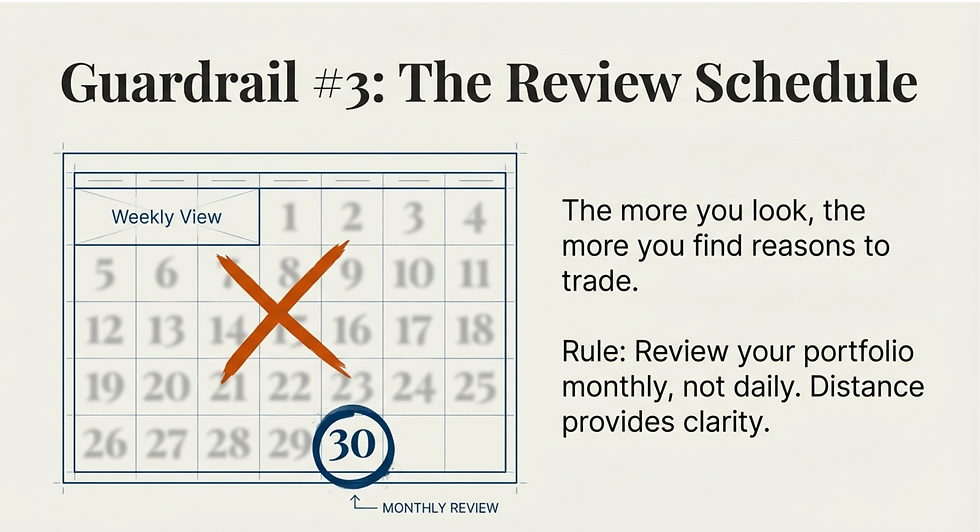
• The Impulse: Daily "portfolio voyeurism" and constant tweaking. The Guardrail: Monthly reviews and Annual rebalancing. Limit your exposure to the "buy/sell" button.
8. Conclusion: The Path to Disciplined Investing Growth
Ultimately, the market does not care about your IQ. It is a machine designed to transfer wealth from the active to the patient, and from the reactive to the disciplined. Successful investing is a test of temperament, not a contest of intellect.
As you look at your accounts today, ask yourself: Are you building a portfolio, or are you just reacting to your own anxiety?

The most "clever" thing you can do, the only thing that truly matters for your net worth is to commit to a simple, repeatable process and have the courage to get out of your own way.
⚠️ Disclaimer
Capital is at risk. Past performance is not indicative of future results. This article is for educational purposes only and does not constitute personal investment advice. Please do your own research and, if needed, consult a regulated financial adviser.
Alpesh Patel OBE www.campaignforamillion.com


Comments