
“I Just Can’t Pull The Trigger” - The Psychology, Neuroscience, and Cure of Investment Paralysis

Updated: Apr 27

You are not alone and you are not irrational. The feeling described as ‘I just can’t pull the trigger’ is one of the most well-documented phenomena in the entire field of behavioural finance. The investors who experience it are, on average, more thoughtful and more intelligent than those who don’t. The problem is not a lack of knowledge. It is that human beings are wired; literally, neurologically to treat investment decisions as threats rather than opportunities.
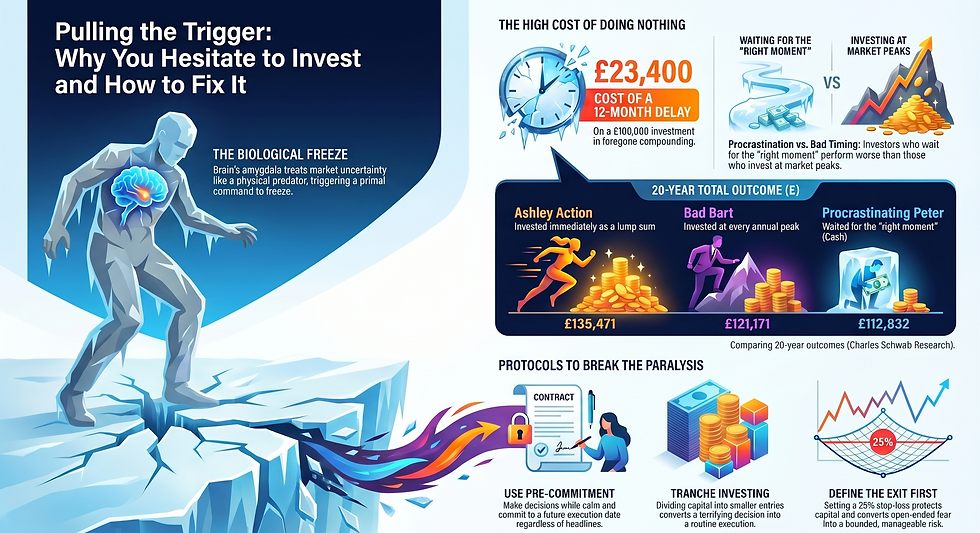
The research is unambiguous on one point: the cost of paralysis; of waiting, hesitating, and perpetually seeking a ‘better moment’ is not zero. It is large, measurable, and compounding. Every week of delay has an arithmetic consequence that no future ‘perfect entry’ can recover.
Alpesh Patel OBE is a hedge fund manager, Bloomberg TV alumnus, Financial Times author, and former Visiting Fellow at Corpus Christi College, Oxford. This report was prepared for Great Investments Programme members experiencing action paralysis in April 2026.
Investment Paralysis Part One: The Arithmetic of Inaction
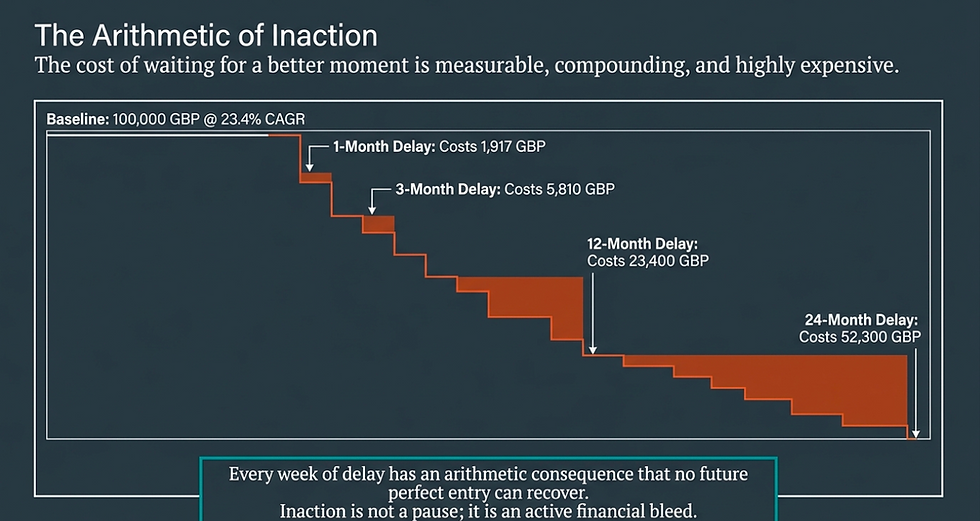
Before examining the psychology, the maths: at a 23.4% CAGR, a £100,000 investment delayed by one month costs £1,917 in foregone compounding. A three-month delay costs £5,810. A 12-month delay costs £23,400. A 24-month delay costs £52,300.
Charles Schwab research tracked five investors over 20 years. Perfect Tanya invested at every absolute market low. Steady Eddie invested on the first day of every year. Ashley Action invested immediately as a lump sum. Procrastinating Peter waited for the ‘right moment’, often staying in cash. Bad Bart invested at every annual peak.
After 20 years: Perfect Tanya had £151,391. Ashley Action had £135,471. Steady Eddie had £134,856. Bad Bart had £121,171. Procrastinating Peter had £112,832. Peter who waited for the right moment did worse than Bad Bart, who invested at every annual high. Being in cash is the worst strategy of all.
The ‘waiting for a drop’ strategy has a further problem: you must be right twice. You must correctly predict the timing of the fall, and then correctly predict when it has bottomed and reversed. Academic research finds that even professional fund managers with full-time analytical resources fail to do this consistently. Perfect timing across the full period from 1926 to 2023 produced a +0.4% advantage over regular investing. That advantage is not worth the wait.
The Ben H V3 GIP portfolio’s worst historical drawdown was -16.5%, lasting 6 months, with a 4-month recovery. An investor who had put money in at the absolute worst possible moment the day before the 2022 decline began would have fully recovered within 10 months and would now be sitting on +169% from that entry point. The market punishes those who wait more than it punishes those who buy at the top.
Investment Paralysis Part Two: The Neuroscience of the Frozen Investor
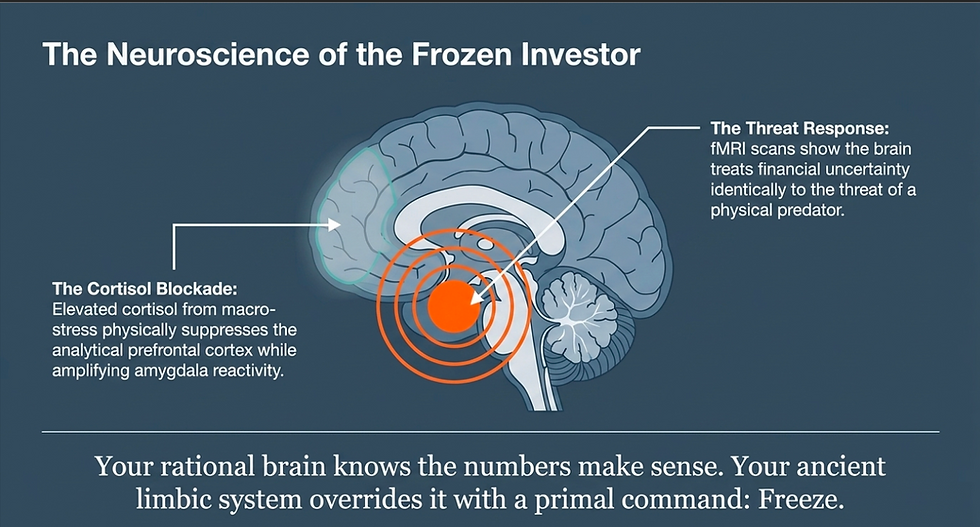
When the human brain evaluates a financial decision under uncertainty, it activates the amygdala — the brain’s threat-detection centre — in exactly the same way it responds to a physical threat. This is not a metaphor. It is measurable on an fMRI scan. Professor Meir Statman of Santa Clara University describes this as the brain treating investment risk the same way it treats the risk of being eaten by a predator. The rational prefrontal cortex knows the analysis supports investing. The ancient limbic system overrides it with a primal command: do nothing. Freeze.
Nobel Prize laureate Daniel Kahneman’s foundational work identifies two modes of thinking. System 1 is fast, automatic, emotional, and instinctive - it fires before you consciously read a scary market headline. System 2 is slow, deliberate, and analytical - it is the part that understood the GIP stock analysis. Under conditions of stress, uncertainty, or market volatility, System 2 is overridden by System 1 every time. The practical implication is profound: the solution to investment paralysis is not more analysis. More analysis feeds System 2, which is not the system causing the paralysis. The solution is to neutralise System 1’s threat response through pre-commitment, structured processes, and rules that remove the moment-of-decision entirely.
Cambridge University professor John Coates found that traders under stress show elevated cortisol levels that materially degrade decision-making quality. Cortisol physically suppresses activity in the prefrontal cortex while amplifying amygdala reactivity. The 2026 geopolitical environment - oil prices, Middle East conflict, market turbulence is a cortisol factory. Every news alert, every market update is a micro-stress event that accumulates into chronic low-level threat response. In this state, the decision to invest feels physically impossible not because the investment case is wrong, but because cortisol is suppressing the brain circuits that could execute it.
Investment Paralysis Part Three: The Seven Biases Keeping You Out of the Market
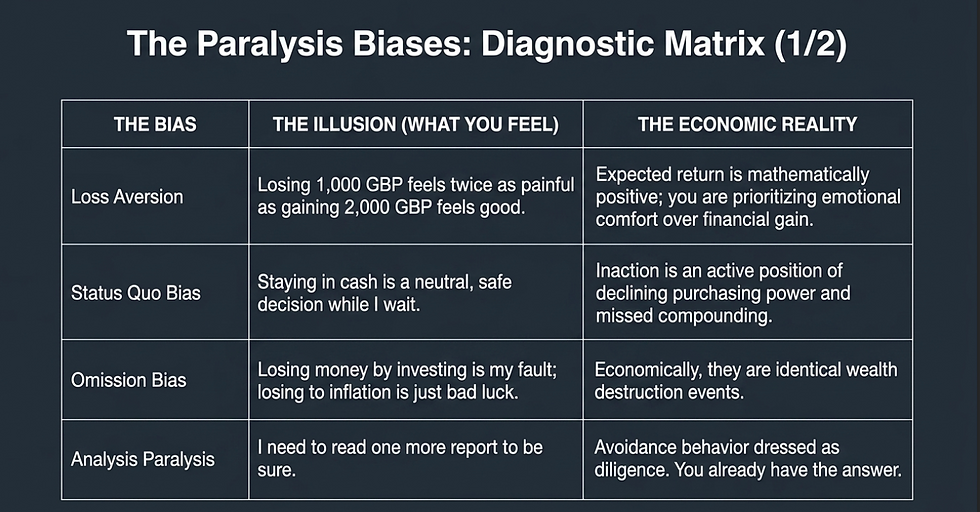
The research literature identifies a consistent cluster of seven cognitive biases that combine to produce action paralysis. They do not operate independently — they reinforce each other in a self-sustaining loop.
1. Loss Aversion
First formalised by Kahneman and Tversky in their 1979 Prospect Theory paper, loss aversion describes the finding that losses are psychologically approximately twice as painful as equivalent gains are pleasurable. Losing £1,000 feels roughly as bad as gaining £2,000 feels good. The mere possibility of a paper loss is generating emotional pain equal to roughly twice the pleasure of an equivalent gain. The analysis says the expected return is positive. The amygdala says the expected pain of being wrong outweighs the pleasure of being right.
2. Status Quo Bias
Identified by Samuelson and Zeckhauser (1988), status quo bias is the tendency to prefer the current state of affairs over any change even when the change is objectively beneficial. Staying in cash is not a neutral act it is an active decision with real economic consequences. Your current position is not ‘safe cash’. Your current position is ‘declining purchasing power, missed compounding, and certain below-inflation return’. Inaction is the risky position.
3. Omission Bias
Studied by Spranca, Minsk and Baron (1991), omission bias describes the tendency to judge harmful actions more negatively than equally harmful omissions. An investor who loses money by investing feels more culpable than an investor who loses the same amount by staying in cash while inflation erodes it. The loss from action feels like a personal failure. The loss from inaction feels like bad luck. Psychologically they are treated differently. Economically, they are identical.
4. Analysis Paralysis
Barry Schwartz documented in The Paradox of Choice (2004) how increasing the number of options available leads not to better decisions but to fewer decisions. Reading one more analyst report, checking one more macroeconomic indicator, or waiting for one more earnings release is not analysis - it is avoidance behaviour dressed up as diligence. You already have the answer. The GIP process exists precisely to reduce the information set to a manageable, quality-filtered output.
5. Regret Aversion
Regret theory, developed independently by Bell (1982) and Loomes & Sugden (1982), proposes that people make decisions not purely on expected utility but on the anticipated regret of a bad outcome. The investor who fears ‘looking stupid’ is optimising to minimise anticipated regret rather than to maximise expected return. The long-run regret of not participating in decades of compounding is measurably and consistently greater than the short-run regret of entering at a suboptimal price.
6. Myopic Loss Aversion
Benartzi and Thaler’s 1995 paper combined loss aversion with short-horizon mental accounting. Investors who check their portfolios daily will see losses far more often than those who check quarterly - even on an identical portfolio because daily returns are roughly 50/50 up and down, while quarterly and annual returns trend positive over time. Every additional viewing of your portfolio between GIP review dates is a decision-quality-degrading act. Turn off price alerts. Unsubscribe from daily market update emails.
7. Ambiguity Aversion
The Ellsberg Paradox (1961) demonstrated that people systematically prefer known risks over unknown risks even when the expected value is identical or better for the unknown option. There is no systematic evidence that periods described as ‘calm’ produce better subsequent equity returns than periods described as ‘uncertain’. The VIX - the ‘fear index’ is a mildly contrarian indicator: elevated VIX has historically preceded above-average 12-month returns. Uncertainty is the permanent condition of markets, not a temporary state to be waited out. The required return premium investors earn from equities is compensation for this permanent uncertainty. You are being paid to invest when things feel uncertain. The discomfort is the product.
Investment Paralysis Part Four: Why ‘Waiting for the Right Moment’ Is a Moving Target
When the market is calm, investors think ‘maybe I should wait for a dip’. When it rises 5%, they feel they’ve missed it and will wait for a correction. When it falls 5%, they fear it’ll go lower. When it falls 10%, they’re certain a crash is coming. When it recovers partially, they say it’s too uncertain. When it returns to an all-time high, they say it feels expensive again and congratulate themselves for waiting, having missed 12 months of gains.
This cycle known in psychology as ‘approach-avoidance conflict’, first described by Kurt Lewin in the 1930s does not resolve itself through waiting. It intensifies. The longer the paralysis, the greater the psychological investment in the waiting position and the harder it becomes to act. After 12 months of waiting, it has become a form of identity.
Investment Paralysis Part Five: The Six Protocols That Work
Protocol One: Pre-Commitment
Thaler and Benartzi’s ‘Save More Tomorrow’ programme solved contribution paralysis not by convincing people to save more today, but by having them commit today to investing at a future date. Pre-commitment works by using System 2 (current, rational, non-stressed) to constrain System 1 (future, emotional, potentially stressed). You make the decision today, when you are calm and analytical. You execute it next week, regardless of how the news looks. Write down the amount, the date, and sign it. Research by Ariely and Wertenbroch (2002) shows that self-imposed commitments of this type are kept at significantly higher rates than unspecified intentions.
Protocol Two: Tranche Investing
If the psychological barrier to full investment is too high, the documented solution is staged entry — investing in equal tranches over a defined period. This is not primarily a market-timing strategy (lump-sum investing outperforms DCA approximately 65% of the time). It is a psychological strategy. The crucial behavioural benefit is not the average price improvement. It is that each subsequent decision to invest is already made. The paralysis is broken at Month 1, and thereafter each tranche is an execution, not a decision.
Protocol Three: Define the Loss Before You Invest
The GIP 25% stop-loss rule serves a dual psychological function: it protects capital, and it converts open-ended fear into bounded risk. Before placing any investment, write down the price at which you will sell. If you buy at 100p, your stop is at 75p. The vague fear of ‘what if everything goes wrong’ is qualitatively different and neurologically more threatening than the concrete fact of ‘my maximum loss on this position is £X’. Research found that investors who had pre-defined exit conditions experienced 40% less decision-paralysis than those who had not.
Protocol Four: Reduce Your Information Diet
Remove from your daily routine: real-time price notifications, financial news alerts, daily portfolio valuation checking, market commentary social media feeds, any content containing the words ‘crash’, ‘recession risk’, or ‘bear market signal’. Keep in your schedule: fortnightly portfolio review (fixed calendar date), monthly GIP update, annual rebalancing review, quarterly long-form investment research. The information you receive daily is mostly noise. The signal emerges only over weeks and months.
Protocol Five: The Regret Minimisation Reframe
Amazon founder Jeff Bezos describes his foundational decision-making tool as the Regret Minimisation Framework: project yourself to age 80, looking back on your life, and ask which decision will you regret more? At 80, the investor who acted: ‘I built a portfolio, captured decades of compound growth, and was rewarded for the discomfort of uncertain times.’ The investor who waited: ‘I spent years waiting for the right moment that never came. I missed the compound growth of some extraordinary businesses. My money sat in cash losing purchasing power. I was never ready, and then I was too old to start.’
Protocol Six: The Six-Step First Entry Protocol
Step 1: Define your starting allocation for a £100k portfolio, this might be £20k–30k. Write it down; the number is now fixed. Step 2: Set the entry date within 14 days, not a price level. Step 3: Equal-weight your first tranche across the 5 highest-conviction names by Sortino and CAGR. Step 4: Write down the 25% stop-loss price for each position before you invest. Step 5: Book a diary entry for 6–8 weeks from now for your second tranche. Step 6: You are allowed to check the portfolio once per fortnight. No more.
The goal of the first investment is not to make money. The goal is to stop being a spectator. The research consistently shows that the first investment is the hardest. The second is dramatically easier. The third is routine. The paralysis is almost always permanently broken by the first execution.
Investment Paralysis Part Six: The Current Macro Environment in Historical Context
Every ‘scary’ macro event in recent history was followed by strong returns. The 1990 Gulf War and oil shock: S&P +26% over the following 12 months. The 2003 Iraq War and SARS: S&P +26%. The 2009 global financial crisis: S&P +65% over 24 months. The 2011 Euro debt crisis and US credit downgrade: S&P +16%. The 2020 COVID pandemic and global shutdown: S&P +70% over 18 months. The 2022 Ukraine war and 40-year high inflation: GIP portfolio recovered in 10 months.
Every single one of these events felt, at the time, like a compelling reason not to invest. Every single one of them was followed by substantial positive returns for investors who acted despite the fear.
Conclusion: The Only Wrong Decision
Sixty years of psychology, neuroscience, and behavioural economics converge on one finding: the only wrong investment decision is the one that is never made. Not the imperfect decision. Not the decision made at a non-optimal price. Not the decision made when the headlines look scary. The one that is indefinitely deferred while the compounding clock keeps running.
The investor who waited for a calm moment throughout the 2021–2026 period would have missed the post-COVID recovery, the 2023 re-rating, the AI-driven bull run of 2024–2025, and the 2026 commodity and defence surge. There was no calm moment. There never is. The permanently available ‘I’ll wait until things settle down’ option is the most expensive option on the menu - it just does not show its price tag until years later.
Your next step: Pick a date within the next 14 days. Write down the amount of your first investment tranche. Commit to it regardless of market conditions on that date. Invest it in your highest-conviction five positions in equal weight. Set your 25% stops. Schedule your next fortnightly portfolio review. Do not check the portfolio between now and that review. That is not recklessness. That is what the evidence says works.
To discuss your own situation and get a GIP portfolio review, book a free portfolio review here
Key Academic References
Kahneman, D. & Tversky, A. (1979). Prospect Theory: An Analysis of Decision under Risk. Econometrica, 47(2), 263–291.
Thaler, R. & Benartzi, S. (1995). Myopic Loss Aversion and the Equity Premium Puzzle. Journal of Political Economy, 103(1), 73–92.
Samuelson, W. & Zeckhauser, R. (1988). Status Quo Bias in Decision Making. Journal of Risk and Uncertainty, 1(1), 7–59.
Coates, J. (2012). The Hour Between Dog and Wolf. Fourth Estate.
Benartzi, S. & Thaler, R. (2004). Save More Tomorrow. Journal of Political Economy, 112(S1), S164–S187.
Schwarz, B. (2004). The Paradox of Choice. HarperCollins.
Kahneman, D. (2011). Thinking, Fast and Slow. Farrar, Straus and Giroux.
Schwab Center for Financial Research (2012). Does Market Timing Work? Charles Schwab Corporation.
Disclaimer: This article is for information and education purposes only. It does not constitute investment guidance, a personal recommendation, or a regulated financial promotion. Past performance does not guarantee future results. All investing carries risk.
Alpesh Patel OBE



Comments