
Procrastinating Peter vs Bad Bart: The Most Important Investment Study You've Never Heard Of

Updated: Apr 27
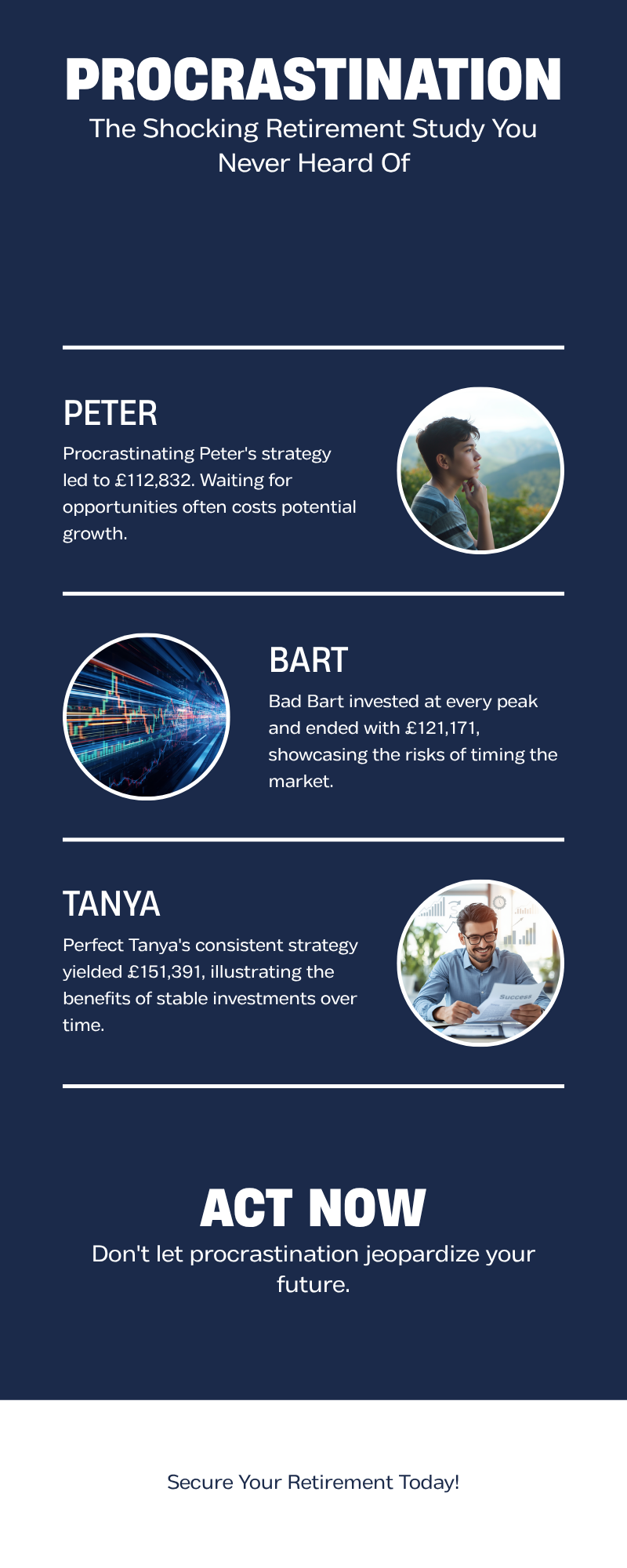
Procrastinating Peter waited for the right moment to invest every year for 20 years. Bad Bart invested at the absolute market peak every year for 20 years. After two decades, Peter had £112,832. Bart had £121,171. The investor who waited for the perfect entry point did worse than the one who chose the worst entry point every single year. Cash is not the safe option. It is the most expensive strategy available to the long-term investor.
The Schwab Center for Financial Research study, published in 2012 under the title 'Does Market Timing Work?', tracked five hypothetical investors who each had £2,000 to invest every year for 20 years into a portfolio tracking the S&P 500.

The methodology was straightforward and the investment vehicle identical across all five. The only variable was the timing of each annual contribution. The results have been replicated, cited, and discussed in the academic literature on market timing for over a decade and they consistently produce the same discomforting conclusion.
Alpesh Patel OBE is a hedge fund manager, Bloomberg TV alumnus, Financial Times author, and former Visiting Fellow at Corpus Christi College, Oxford. In over two decades of reviewing investor portfolios, the pattern described in this post — intelligent, research-oriented investors systematically underperforming because of cash-holding behaviour — is one of the most consistent findings of his work.
The Schwab Investment Study: Five Investors, Twenty Years, One Brutal Conclusion
Perfect Tanya invested at the absolute market low every year - flawless timing across two decades. Ashley Action invested immediately upon receiving funds each year, no timing attempt. Steady Eddie invested on the first day of each calendar year, mechanically and automatically. Bad Bart invested at the absolute market peak every year. Procrastinating Peter held his £2,000 in cash each year, waiting for the right moment, often missing the market entirely. After 20 years: Tanya £151,391. Ashley £135,471. Eddie £134,856. Bart £121,171. Peter £112,832.

The gap between Tanya (perfect timing) and Ashley (no timing) was £15,920 — barely 10% of the final portfolio. The gap between Ashley (immediate investment) and Peter (perpetual waiting) was £22,639 - larger than the entire advantage of perfect market timing, lost to hesitation.
Perfect timing across 20 years produces only a 0.4% annual advantage over immediate investment. The Schwab research team ran further sensitivity analyses across different 20-year periods in US market history and found the same qualitative result every time: being invested outperformed being uninvested while waiting.
The Arithmetic of Delay: What Waiting Costs in Pounds

At a 23.4% compound annual growth rate — the historical track record of the GIP framework — every month of delay on a £100,000 investment has a specific, calculable price. A one-month delay costs £1,917. A three-month delay costs £5,810. A six-month delay costs £11,942. A 12-month delay costs £23,400. A 24-month delay costs £52,300. These are not losses in the conventional sense - no money has been taken from you. But they are real foregone returns that will never be recovered, because compounding is a one-way clock. The framework was established by Irving Fisher in The Theory of Interest (1930): money has a time value, and a pound today is worth more than a pound tomorrow because today's pound can begin compounding immediately.
There is a further dimension: cash itself has a negative real return in most environments. UK CPI inflation peaked at 11.1% in October 2022. During that period, cash in a savings account earning 3% was generating a real return of approximately -8% per year. The investor who stayed in cash during 2022 waiting for the market to fall did not escape the fall - they experienced it in purchasing power terms while also missing the recovery that followed. The illusion of cash safety is constructed by the fact that the nominal number on a bank statement does not decline. The real value does.
Why Bad Bart Beat Peter: The Compounding Advantage of Being Invested
Bart owned assets. Those assets paid dividends. Those dividends were reinvested. His capital appreciated and fell with the market but over the long run, the market's upward trajectory, documented from 1926 to the present by Morningstar and Ibbotson Associates, means that even bad entry points resolve to positive returns given sufficient time. Finance professor Jeremy Siegel of the Wharton School demonstrated in Stocks for the Long Run (1994, updated 2022) that US equities have returned approximately 6.7% real per year since 1802 - across wars, depressions, panics, and geopolitical crises. The most relevant data point: Siegel found that any rolling 20-year period in US equity market history has produced a positive real return. Without exception. Bad Bart was inside that guarantee. Peter was not.
The 'Waiting for a Dip' Problem: Why You Must Be Right Twice

Waiting for a correction requires two correct predictions, not one. First, you must correctly predict that a fall is coming and roughly when. Second, you must correctly predict when the fall has ended because investing at the bottom, before any recovery, is what produces the superior return. The evidence on professional market timing is clear. SPIVA data published by S&P Dow Jones Indices in their 2024 UK Scorecard found that 87% of actively managed UK equity funds failed to beat their benchmark over 10 years. These are full-time professionals with analytical teams, real-time data, and multi-million-pound research budgets. If they cannot do it consistently, the probability that an individual investor can time a 10-15% correction with the precision required to outperform immediate investment is vanishingly small.
The Psychology: Loss Aversion and Status Quo Bias
Peter's behaviour is the predictable output of two well-documented cognitive biases operating simultaneously. The first is loss aversion, formalised by Daniel Kahneman and Amos Tversky in their 1979 Prospect Theory paper published in Econometrica — one of the most cited papers in the history of economics. Kahneman and Tversky demonstrated that losses are psychologically approximately twice as painful as equivalent gains are pleasurable. The anticipation of a potential paper loss after investing generates emotional pain that disproportionately outweighs the rational expected value calculation.
The second bias is status quo bias, identified by economists William Samuelson and Richard Zeckhauser in their 1988 paper in the Journal of Risk and Uncertainty. They found through controlled experiments that people systematically prefer their current situation over alternatives, even when the alternatives are demonstrably superior. For the investor holding cash, cash is the status quo. The psychological friction of departing from it not any rational calculation is what keeps Peter in cash. The two biases interact directly: loss aversion makes a potential post-investment paper loss feel intolerable; status quo bias makes the cash-holding position feel neutral and safe. The arithmetic reality is precisely the opposite.
The GIP Solution: Pre-Commitment and the Tranche Entry Protocol
The academic literature on overcoming cash-holding behaviour converges on pre-commitment. Richard Thaler and Shlomo Benartzi's 2004 paper 'Save More Tomorrow', published in the Journal of Political Economy, demonstrated that employees enrolled in a programme that committed them to future contribution increases dramatically outperformed those who relied on their own motivation. The key mechanism: the commitment was made in advance by the rational, non-stressed version of the person and executed automatically, bypassing the emotional resistance that typically prevents action. Research by Dan Ariely and Klaus Wertenbroch, published in Psychological Science in 2002, confirmed that self-imposed commitments are followed at significantly higher rates than unspecified intentions.
The lesson from the Schwab study, from Siegel's long-run equity data, from SPIVA's active fund research, and from two decades of GIP portfolio reviews is consistent: the question is never whether to invest. The question is only whether to start today or to pay the compounding cost of tomorrow.
Frequently Asked Questions
Should I wait for the market to drop before investing in the UK?
Waiting for a market drop is statistically counterproductive in most circumstances. The Schwab Center for Financial Research (2012) found that perfect market timing across 20 years produced only a 0.4% annual advantage over immediate investment with no timing at all. Waiting for a correction requires predicting both when the fall will happen and when it has bottomed — a double prediction that even professional fund managers consistently fail to make. SPIVA 2024 data shows 87% of active UK fund managers fail to beat their benchmark over 10 years. For most investors, the cost of waiting exceeds the expected benefit of better timing.
Is it better to invest a lump sum or drip-feed into a SIPP or ISA?
Lump-sum investing outperforms drip-feeding approximately 65% of the time over 12-month horizons, according to Vanguard research updated in 2012, because money invested earlier has more time to compound. However, drip-feeding is a superior psychological strategy for investors who cannot commit to a lump sum. In the GIP framework, a four-tranche entry over 16 weeks is recommended as a compromise: the first tranche starts compounding immediately, and the remaining tranches are already committed, removing the decision pressure from each subsequent entry.
How much does waiting to invest actually cost over time?
At a 23.4% CAGR on a £100,000 portfolio, a one-month delay costs approximately £1,917 in foregone compounding, a six-month delay costs £11,942, and a 12-month delay costs £23,400. On a £500,000 portfolio at 13% growth, a 12-month delay costs approximately £65,000. These are not hypothetical losses — they are real, calculable foregone returns that compound into larger gaps over time. The compounding clock runs continuously. Every day in cash rather than in a compounding portfolio has a measurable price that is invisible on a bank statement.
What is the best time to invest in the UK stock market?
The best time to invest is as soon as you have capital allocated for investment and a systematic framework for stock selection. The second-best time is today. The Schwab (2012) research, Siegel's Stocks for the Long Run data, and SPIVA evidence all converge: time in the market consistently outperforms timing the market. Within the GIP framework, where the holding horizon is a minimum of three years and the investment thesis is quantitatively selected, the entry timing within any given month is statistically insignificant to the final outcome over a 10- to 20-year investment horizon.
Why do investors hold cash instead of investing even when they know they should?
Holding cash despite knowing the investment case is sound is the result of two interacting cognitive biases. Loss aversion (Kahneman & Tversky, 1979) makes the prospect of a paper loss approximately twice as psychologically painful as an equivalent gain would be pleasurable. Status quo bias (Samuelson & Zeckhauser, 1988) makes the cash-holding position feel neutral and safe — when it is an active decision with a measurable compounding cost. The combination produces a state where cash feels like the safe default and investment feels like the risky choice, when the arithmetic reality is precisely the opposite.
What is the Schwab market timing study and what does it show?
The Schwab Center for Financial Research study (2012), 'Does Market Timing Work?', tracked five hypothetical investors over 20 years, each contributing $2,000 annually to an S&P 500 index portfolio. They differed only in timing: perfect, immediate, first-of-year, worst possible (market peak), and cash-holding while waiting. The investor who held cash and waited finished last — behind even the worst-timing investor — because being invested in a compounding asset, even at bad prices, outperforms being uninvested in cash. The result has been replicated across different 20-year periods and international markets.
If you recognise Peter's pattern in yourself and want a structured, systematic first-entry plan built around the GIP framework, book a free portfolio review here
Academic Sources & Further Reading
Schwab Center for Financial Research (2012). Does Market Timing Work? Charles Schwab Corporation.
Kahneman, D. & Tversky, A. (1979). Prospect Theory: An Analysis of Decision under Risk. Econometrica, 47(2), 263–291.
Samuelson, W. & Zeckhauser, R. (1988). Status Quo Bias in Decision Making. Journal of Risk and Uncertainty, 1(1), 7–59.
Siegel, J. (1994, updated 2022). Stocks for the Long Run. McGraw-Hill.
Thaler, R. & Benartzi, S. (2004). Save More Tomorrow. Journal of Political Economy, 112(S1), S164–S187.
Ariely, D. & Wertenbroch, K. (2002). Procrastination, Deadlines and Performance. Psychological Science, 13(3), 219–224.
S&P Dow Jones Indices — SPIVA UK Scorecard 2024.
Disclaimer: This article is for educational purposes only. All figures are illustrative based on historical data. All investing carries risk. Past performance is not a reliable indicator of future results. This does not constitute personal financial guidance.
Alpesh Patel OBE | www.campaignforamillion.com



Comments