
Every Market News Alert You Read Is Physically Degrading Your Investment Decisions

Updated: Apr 27
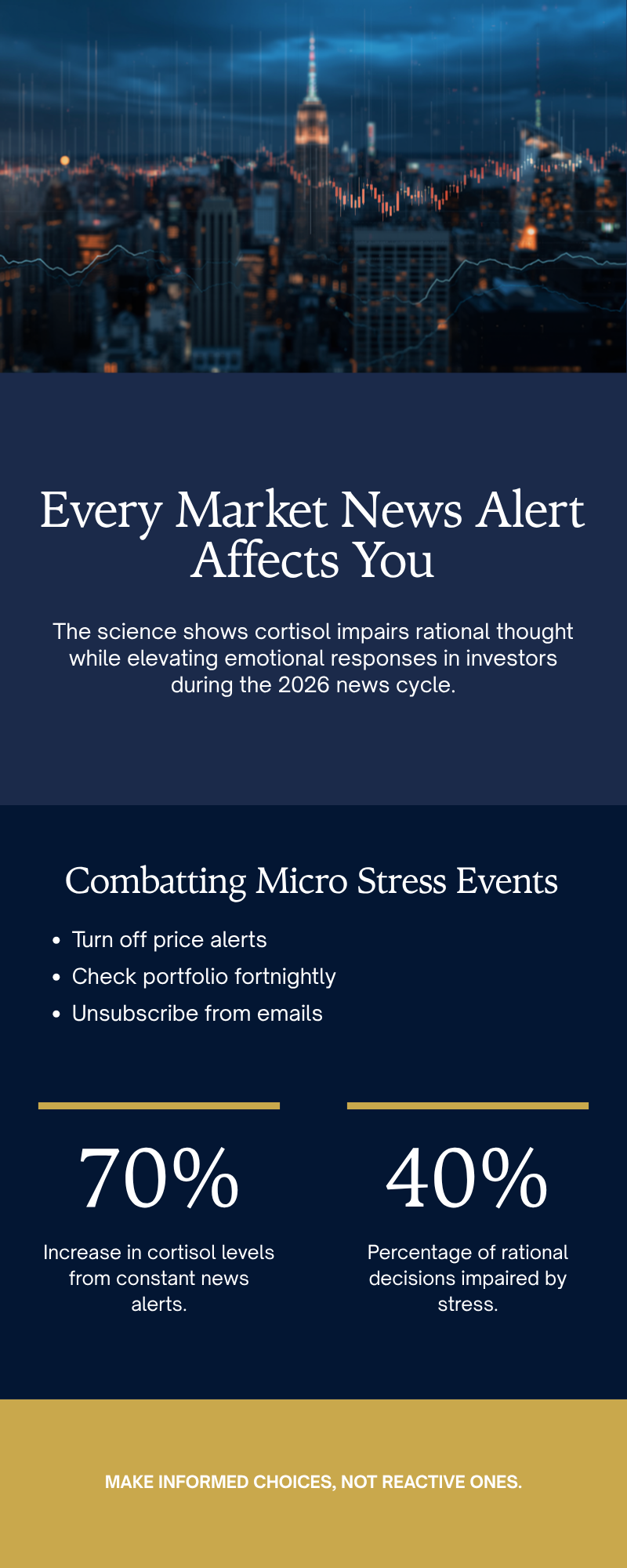
Cortisol is the primary stress hormone in the human body. When it rises, it suppresses the prefrontal cortex where rational analysis and long-term planning occur and amplifies the amygdala, the brain’s threat-detection centre. Every financial news alert you consume is a cortisol event. Across a day of checking prices, reading market commentary, and absorbing headlines about crashes and geopolitical risk, the accumulated cortisol load materially degrades investment decision quality, a finding measured in real time on real traders by Cambridge professor John Coates.

Alpesh Patel OBE is a hedge fund manager, Bloomberg TV alumnus, Financial Times author, and former Visiting Fellow at Corpus Christi College, Oxford. Reducing the information diet is often the first practical intervention in GIP portfolio reviews, before any portfolio change is made.
John Coates and the Biology of Financial Decision-Making
Coates spent a decade as a derivatives trader at Goldman Sachs and Deutsche Bank before completing a PhD in neuroscience at Cambridge and joining the university’s department of physiology, development, and neuroscience. His research applied neuroscience methodology to financial risk-taking. Published in The Hour Between Dog and Wolf (2012), his primary finding: testosterone and cortisol levels among traders followed predictable patterns tied to market conditions. During rising markets, testosterone elevated — increasing confidence and risk appetite. During volatility and uncertainty, cortisol elevated, increasing risk aversion and the tendency to freeze rather than act. The critical finding was causal, not merely correlational. Elevated cortisol made traders less able to think rationally, not merely reflective of their anxiety.
The neurological mechanism operates through two parallel pathways. Cortisol suppresses synaptic activity in the prefrontal cortex; the region responsible for abstract reasoning, probability assessment, and long-term planning. Simultaneously it elevates the sensitivity of the amygdala, the brain’s primary threat-detection centre. Under elevated cortisol, the amygdala’s fear signals become disproportionately loud relative to the prefrontal cortex’s analytical outputs. The investor literally cannot hear their rational analysis over the biological noise of the fear response. This is not metaphor. It is measurable neurophysiology.
The Two-System Framework: Why More Information Makes Paralysis Worse
Coates’s biological findings connect directly to the dual-process theory of cognition developed by Nobel laureate Daniel Kahneman, published in Thinking, Fast and Slow (2011) and supported by the landmark 1974 Science paper with Amos Tversky, ‘Judgment Under Uncertainty: Heuristics and Biases’. Kahneman’s framework distinguishes System 1 - fast, automatic, emotional, instinctive - from System 2 - slow, deliberate, analytical, rational. System 1 evolved to detect physical threats with speed. It does not distinguish between a predator and a -3% Bloomberg alert. System 2 is the analytical intelligence that evaluates CROCI and PEG ratios. Under elevated cortisol, System 2 outputs are suppressed and System 1 outputs are amplified. More information feeds System 2, which is not causing the paralysis. More information also generates more cortisol. The solution is information restriction, not information addition.
Myopic Loss Aversion: The Research Behind Checking Your Portfolio Less
Shlomo Benartzi and Richard Thaler’s 1995 paper ‘Myopic Loss Aversion and the Equity Premium Puzzle’, published in the Journal of Political Economy, combined loss aversion (Kahneman & Tversky, 1979) with short-horizon mental accounting to explain why investors demand a 6% equity premium over bonds when the long-run volatility of equities should only justify approximately 1%. Their answer was frequency of evaluation. A portfolio checked daily shows a loss approximately 47% of the time because daily returns are roughly 50/50 up and down. The same portfolio checked quarterly shows a loss approximately 30% of the time. Checked annually, 25%. Each loss observation triggers loss aversion: losses twice as painful as equivalent gains. Daily checkers accumulate vastly more psychological pain than quarterly checkers on an identical portfolio with identical returns.
Benartzi and Thaler modelled the optimal evaluation frequency for an investor with standard loss aversion coefficients and found it to be approximately once per year. A daily-checking investor would, given those coefficients, rationally prefer bonds to equities despite the equity risk premium because the daily psychological cost of loss experiences exceeds the pleasure of superior expected returns. The GIP fortnightly review recommendation derives directly from this research: the minimum frequency for systematic oversight, and anything more frequent adds cortisol load without adding actionable information.
Maximum Fear Precedes Maximum Returns
Ned Davis Research has documented across multiple market cycles that the best single-day and single-month equity returns cluster around periods of maximum fear and volatility. This is structural, not coincidental. When fear is highest, prices are lowest relative to underlying business value. The CBOE VIX - the volatility index, widely called the fear index has historically been a mildly contrarian indicator. Research by Wharton School professor Robert Stambaugh found that elevated VIX environments have historically preceded above-average 12-month returns. The VIX is a market-wide cortisol reading. When it is highest, the biologically-driven avoidance response is strongest and the expected return for acting against that response is greatest. The discomfort is not a warning signal. It is the mechanism by which the market compensates investors for acting when others cannot.
The Information Diet Protocol
Remove immediately: real-time price alerts; Bloomberg, Reuters, and FT push notifications; daily portfolio checking; financial news on social media; any content containing the phrases ‘crash’, ‘recession risk’, or ‘worst since’. These are pure cortisol triggers with no actionable content for a long-term investor.
Retain in your schedule: fortnightly portfolio review on a fixed calendar date; monthly GIP Approved List update; annual rebalancing review; quarterly long-form investment research examining business fundamentals. Every additional check between review dates is a loss aversion activation event that degrades decision quality without adding actionable information. This is a neurologically-grounded prescription derived from the Benartzi and Thaler (1995) research, not a casual preference.
Frequently Asked Questions
Does watching financial news affect investment decisions?
Yes, and the mechanism is physiological. Cambridge professor John Coates demonstrated in The Hour Between Dog and Wolf (2012) that market volatility elevates cortisol in financial professionals, suppressing prefrontal cortex activity (rational analysis) and amplifying amygdala reactivity (fear and avoidance). Financial news is structurally designed to generate mild anxiety because anxiety retains audience attention and generates advertising revenue. Regular financial news consumption produces a chronic low-level cortisol state that makes it harder to execute investment decisions even when the rational case is clear.
How often should I check my investment portfolio UK?
The GIP framework recommends fortnightly portfolio review as the minimum frequency. This derives from Benartzi and Thaler’s 1995 research on myopic loss aversion: an investor checking daily sees a loss approximately 47% of the time, generating disproportionate psychological pain due to loss aversion (losses twice as painful as equivalent gains). Annual checking is optimal from a decision-quality perspective — but fortnightly provides the minimum systematic oversight needed. Anything more frequent than fortnightly adds cortisol load without adding usable information.
What is the VIX fear index and does high VIX mean I should invest?
The VIX is the CBOE Volatility Index, measuring implied volatility from S&P 500 options prices. It rises when investors price in higher uncertainty. Counterintuitively, elevated VIX has historically preceded above-average 12-month equity returns — confirmed by Wharton School professor Robert Stambaugh’s research. When VIX is high, stock prices reflect maximum fear-driven selling, meaning they are closest to trading below their underlying business value. The cortisol you feel when VIX is high is not a warning sign. It is the mechanism by which the market compensates investors for acting when others cannot.
Why do I feel scared to invest when markets are falling?
The fear is physiologically real. Coates’s research shows market uncertainty triggers cortisol release the same way a physical threat would — because the amygdala evolved to respond to danger with an undiscriminating threat response. It does not distinguish between a predator and a falling portfolio value. The prefrontal cortex (rational analysis) is simultaneously suppressed by the cortisol, making it harder to access the reasoning that the investment case remains sound. The fear is not investment signal. It is neuroscience. The correct response is information restriction, pre-commitment, and systematic process — not more research.
What is myopic loss aversion in investing?
Myopic loss aversion is a concept developed by Benartzi and Thaler (1995) combining loss aversion (losses approximately twice as psychologically painful as equivalent gains) with short-horizon portfolio evaluation. Investors who check portfolios frequently experience more loss events, even on portfolios with strong long-term returns, because short-term market movements are roughly 50/50. Each loss event generates disproportionate psychological pain. The cumulative result is excessive risk aversion, lower equity allocations, and worse long-term returns than investors who check less frequently — a documented explanation for why investors historically underperform the markets they invest in.
How can I make better investment decisions when stressed about markets?
The most evidence-based approach is reducing the stress inputs rather than attempting to override the stress response. Remove financial news alerts and daily portfolio checking. Make investment decisions in advance via pre-commitment rather than in the moment. Follow a rules-based systematic framework (like the GIP five-screen process) that removes discretion from the high-cortisol decision moment. Schedule reviews at fixed calendar dates rather than reacting to market events. Reducing cortisol load — rather than attempting to overcome it with willpower — is the Coates-derived and Benartzi-Thaler-derived intervention.
To build a systematic, low-cortisol investment process around the GIP framework, book a free GIP portfolio review here
Academic Sources & Further Reading
Coates, J. (2012). The Hour Between Dog and Wolf. Fourth Estate.
Benartzi, S. & Thaler, R. (1995). Myopic Loss Aversion and the Equity Premium Puzzle. Journal of Political Economy, 103(1), 73–92.
Kahneman, D. (2011). Thinking, Fast and Slow. Farrar, Straus and Giroux.
Kahneman, D. & Tversky, A. (1974). Judgment Under Uncertainty: Heuristics and Biases. Science, 185(4157), 1124–1131.
Statman, M. (2011). What Investors Really Want. McGraw-Hill.
Disclaimer: This article is for educational purposes only. All investing carries risk. This does not constitute personal financial guidance.
Alpesh Patel OBE | www.campaignforamillion.com


Comments