
How Professional Investors Actually Analyse Stocks: The Filter Framework That Rejects 94% Before Selection

Updated: May 5
Most retail investors ask the wrong question. They ask 'what should I buy?' The professional question is 'what survives the filter?' This is not a small distinction. It is the entire structural difference between how amateur and institutional capital approach stock selection, and it accounts for most of the return gap between the two populations.
When the question is 'what should I buy', every news headline, podcast tip, social media post, and hot take feels like a candidate. The shortlist is unbounded, and the decision becomes emotional, narrative-driven, and easily distorted by the most confident voice in the room.
How Professional Investors Actually Analyse Stocks
This is how retail investors end up with portfolios that look like a timeline of the last twelve months of financial news, and it is why those portfolios underperform. The universe is too big and the filter is too weak.
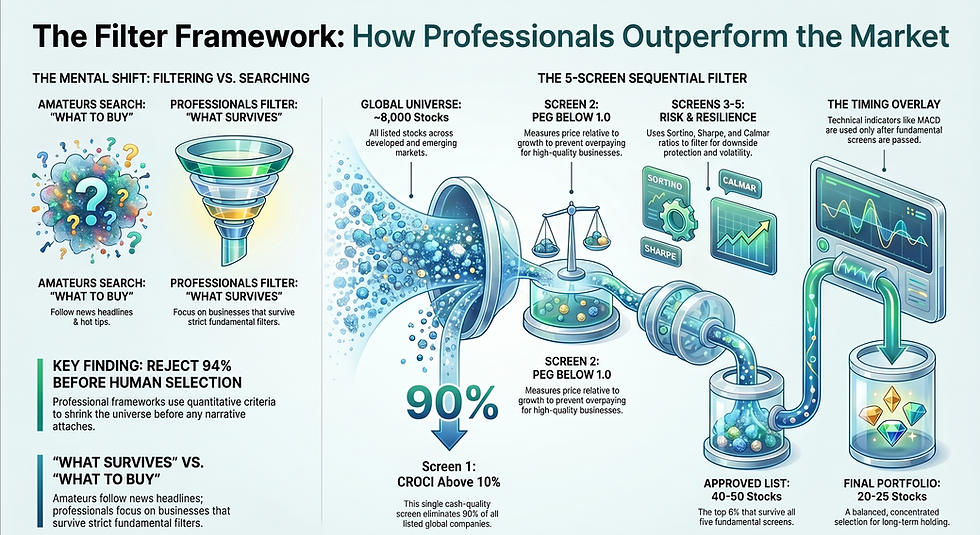
When the question is 'what survives the filter', the universe shrinks before any narrative attaches to it. The framework rejects 94% of the global equity universe through quantitative criteria before a human even looks at the list.
The remaining 6% is small enough to evaluate properly and screened enough to be worth the time. This is the structural shift that separates institutional and retail outcomes, and any retail investor can adopt it.
To really understand how markets work, you need to look at how professional investors actually analyse stocks, because their process is far more about filtering out bad ideas than chasing good ones.
The Funnel: 8,000 stocks to 50 finalists
The Great Investments Programme starts with the global equity universe of approximately 8,000 listed stocks across major developed and large emerging markets. It runs each stock through five sequential quantitative screens. Stocks failing any one screen are removed before the next runs. The output is the GIP Approved List, typically 40 to 50 stocks at any point, refreshed weekly as fundamentals and prices change.
The five screens are not arbitrary. Each targets a specific investment risk that retail investors typically miss because they look at the wrong number. Together they remove the four categories of stock that destroy long-run returns: low-quality businesses dressed up by accounting choices, high-quality businesses bought at prices that do not justify the growth, businesses with downside volatility that wrecks compounding, and businesses with deep historical drawdowns that may not recover within the holding horizon. Each screen removes a different failure mode.
Screen 1: CROCI (cash quality, removes 90%)

Cash Return on Capital Invested measures real cash profit relative to the actual capital deployed in the business, adjusted for inflation and replacement cost. Developed by Deutsche Bank's equity research team in the 1990s, it sidesteps the accounting tricks (depreciation choices, capitalised expenses, asset writedowns) that flatter standard ROE and ROCE figures. The threshold is CROCI above 10%. A business below that level is not generating meaningful cash returns above the typical cost of capital for a developed market company. Approximately 90% of the global equity universe fails this single screen.
That figure is not unusual, and the fact that it shocks most retail investors is the problem. If you take one thing from this article, take this: 90% of listed companies do not generate enough real cash to justify their valuations. The reason your portfolio underperforms is not bad timing. It is owning the 90%. The first screen is the most ruthless because it is the most important.
Screen 2: PEG ratio (price relative to growth)

Price-Earnings-to-Growth ratio (Peter Lynch's adaptation of P/E) measures whether you are paying a reasonable price for the growth you expect. A PEG of 1.0 means the P/E ratio equals the expected earnings growth rate. Below 1.0 is structurally cheap relative to growth; above 2.0 is structurally expensive. The threshold is PEG below 1.0.
Combined with the CROCI filter, this removes most of the high-quality business stocks that have been bid to expensive valuations. A great business at the wrong price is still a poor investment. Apple at 50x earnings is a different proposition from Apple at 15x earnings, regardless of whether the underlying business is unchanged. PEG does not replace fundamental analysis; it prevents you from overpaying for the business you have already fundamentally approved.
Screen 3: Sortino ratio (downside-adjusted return)

Sortino ratio measures excess return per unit of downside volatility. Unlike the more common Sharpe ratio, it penalises only negative volatility, not all volatility. A stock that rises sharply and falls modestly will have a high Sortino ratio. A stock that rises and falls in equal measure will have a much lower one. The threshold is Sortino above 1.0.
This matters for compounding because losses are mathematically more expensive to recover than gains are to bank. A stock with strong upside but worse downside (negative Sortino) consistently destroys portfolio compounding even when it ends the period higher. The return arrives but the drawdown path makes it effectively unusable for anyone who needs the capital within their investing lifetime. Sortino catches this before it happens, which is why it belongs in a filter designed to prevent the five behavioural mistakes that destroy retail returns.
Screen 4: Sharpe ratio (volatility-adjusted return)

Sharpe ratio measures excess return per unit of total volatility (William Sharpe, 1966). Where Sortino targets downside, Sharpe targets the smoothness of the return path. A positive Sharpe means the stock has produced more return than would be expected for its volatility relative to the risk-free rate. A negative Sharpe means the volatility has not been rewarded with adequate return. The threshold is positive Sharpe.
This filter removes stocks that have moved a lot without going anywhere meaningful, including most penny stocks, most pre-revenue tech, and most thematic story stocks where the volatility has not produced compounded value for holders. The pattern is a stock that attracts attention with dramatic moves, but whose holders over time earn a return not much different from cash, adjusted for the stress of holding it. Sharpe filters that entire category in a single line of code. It is one of the least loved and most useful screens in systematic investing.
Screen 5: Calmar ratio (drawdown resilience)

Calmar ratio (Terry Young, 1991) measures annualised return divided by maximum historical drawdown. It captures the asymmetry between the return a stock has produced and the worst loss it has ever inflicted on holders. A high Calmar means strong return with shallow worst-case drawdown. A low Calmar means meaningful return that came with a brutal loss along the way.
For a long-term investor, Calmar matters more than most people realise. A stock with a strong long-run return profile and a 70% historical drawdown will probably produce another 70% drawdown at some point. If that happens late in the holding period, the recovery may not arrive before retirement. Calmar lets you reject those stocks before they break the plan, which is why it closes out the five-screen filter.
What MACD adds (and what it does not)
Once a stock passes all five fundamental screens, technical timing becomes a useful overlay for entry and exit. MACD (Moving Average Convergence Divergence, Gerald Appel, 1979) measures the relationship between two exponential moving averages of price.
A bullish crossover (faster MA crossing above slower MA) signals that price momentum has shifted positively. A bearish crossover signals the opposite. MACD is the most widely used momentum indicator in systematic investing, partly because it is robust across timeframes.
MACD does not tell you what to buy. The fundamental screens do that. MACD tells you when the price action of an already-screened stock has shifted in a direction worth acting on. Used in isolation it is noise. Used as the timing layer on a fundamental shortlist it materially improves entry quality.
This is the order that matters. Fundamentals select the universe of acceptable stocks. Technicals time the entries within that universe. Reversing the order (using technicals to identify what to buy and fundamentals to confirm) is what most retail investors do, and it is why most retail technical analysis underperforms a buy-and-hold of the broader index. The sequence is not cosmetic; it determines whether the framework works at all.
Why this is filtering, not searching
The mental shift required is from active search ('I am looking for the next Nvidia') to passive filtering ('I will own whatever passes the screens'). The first approach is exciting, generates lots of trading, and produces the average retail outcome. The second approach is unexciting, generates very few trades, and produces materially better long-run results because the universe of considered stocks is structurally cleaner. Boring beats exciting over 20 years.
The GIP Approved List of 40 to 50 stocks is the output of running the filter every week. The investor's job is not to second-guess which of those 40 are the 'best', because that reintroduces the exact discretionary decision-making the filter was built to remove. The job is to construct a balanced 20 to 25 stock portfolio from the list, hold each position with conviction, rebalance annually, and let the filter do its job in updating the list as conditions change. I describe what that portfolio construction looks like in how to build a portfolio that lasts decades.
Good investing isn't about finding ideas. It's about filtering them properly.
Frequently Asked Questions
What is the best stock analysis framework for retail investors UK 2026?
A systematic five-screen framework that filters the global equity universe before human selection. The Great Investments Programme uses CROCI above 10% (cash quality), PEG below 1.0 (price relative to growth), Sortino above 1.0 (downside-adjusted return), positive Sharpe (volatility-adjusted return), and strong Calmar (drawdown resilience). Run sequentially against 8,000 global stocks, the screens reject 94% and produce a weekly Approved List of 40-50 names. The investor then constructs a 20-25 stock portfolio from the approved list.
What is CROCI and how do professional investors use it?
CROCI stands for Cash Return on Capital Invested. Developed by Deutsche Bank's equity research team in the 1990s, it measures real cash profitability relative to the inflation-adjusted replacement cost of capital deployed. The threshold for systematic frameworks is CROCI above 10%. Approximately 90% of listed global stocks fail this screen, meaning they are not generating enough real cash to justify their valuations. CROCI is harder to manipulate than ROE or ROCE because it strips out the accounting choices that flatter standard profitability measures.
What is the PEG ratio and how is it different from P/E?
PEG ratio (Peter Lynch, 1989) divides the P/E ratio by the expected earnings growth rate. A PEG of 1.0 means the price-to-earnings multiple equals the growth rate. Below 1.0 is structurally cheap relative to growth; above 2.0 is structurally expensive. PEG corrects the major weakness of standalone P/E, which fails to distinguish between a stock that is cheap because the business is contracting and one that is cheap relative to genuine growth. A stock with a P/E of 30 and 30% growth is cheaper than a stock with a P/E of 10 and 5% growth.
What is the Sortino ratio in stock analysis?
Sortino ratio (Frank Sortino, 1994) measures excess return per unit of downside volatility. Unlike Sharpe ratio, which penalises all volatility equally, Sortino penalises only negative deviations from the target return. A stock with strong upside and modest downside has a high Sortino ratio. The threshold for systematic stock screening is Sortino above 1.0. This matters because losses are mathematically more expensive to recover than gains are to bank, so the asymmetric view of volatility is more relevant for long-term compounding than a symmetric one.
How do I screen stocks like a hedge fund manager UK?
Use a sequential quantitative filter that rejects most of the universe before any human judgement is applied. Run global stocks through CROCI above 10%, PEG below 1.0, Sortino above 1.0, positive Sharpe, and a strong Calmar ratio. Apply MACD as a timing overlay only after a stock has passed all five fundamental screens. The output is a small list of approved candidates from which to construct a 20-25 stock concentrated portfolio. The key behavioural shift is from searching for stocks to filtering the universe.
What technical indicators do professional investors use?
Most professional systematic investors use technical indicators only as entry and exit timing overlays on a fundamentally screened universe. The most common are MACD (moving average convergence-divergence), RSI (relative strength index), and simple moving average crossovers. Used in isolation as the primary selection tool, technical indicators have not produced consistent retail outperformance. Used as timing on a quality-screened shortlist, they materially improve entry and exit quality. The sequence matters: fundamentals first, technicals second.
Related reading
Sources
Sharpe, W. (1966). Mutual Fund Performance. Journal of Business, 39(1). | Sortino, F. and Price, L. (1994). Performance Measurement in a Downside Risk Framework. Journal of Investing. | Lynch, P. (1989). One Up On Wall Street. Simon and Schuster. | Young, T. (1991). The Calmar Ratio. Futures Magazine. | Appel, G. (1979). The Moving Average Convergence-Divergence Trading Method. | Deutsche Bank Equity Research, CROCI methodology papers.
Alpesh Patel OBE is a hedge fund manager, Bloomberg TV alumnus, Financial Times author, and former Visiting Fellow at Corpus Christi College, Oxford. He is the founder of the Great Investments Programme.
This article is for educational and informational purposes only. It does not constitute personal financial guidance. Past performance is no guarantee of future results. Capital is at risk.



Comments